Saturday, 17 October 2015

FRANCE'S TOP WEATHERMAN SUSPENDED OVER CLIMATE SCEPTIC BOOK

I will be very surprised if this makes the TV news bulletins here in the UK, though it should as it is a very interesting story. If any readers around the world see it, then please let me know via the comments. What great timing by Mr Verdier!

The Daily Telegraph, 14 October 2015

Henry Samuel
 
Philippe Verdier, weather chief at France Télévisions, the country’s state broadcaster, reportedly sent on “forced holiday” for releasing book accusing top climatologists of “taking the world hostage”
Mr Verdier claims in the book Climat Investigation that leading climatologists and political leaders have “taken the world hostage” with misleading data.

In a promotional video, Mr Verdier said: “Every night I address five million French people to talk to you about the wind, the clouds and the sun. And yet there is something important, very important that I haven’t been able to tell you, because it’s neither the time nor the place to do so.”

He added: “We are hostage to a planetary scandal over climate change – a war machine whose aim is to keep us in fear.”

His outspoken views led France 2 to take him off the air starting this Monday. “I received a letter telling me not to come. I’m in shock,” he told RTL radio. “This is a direct extension of what I say in my book, namely that any contrary views must be eliminated.”

The book has been released at a particularly sensitive moment as Paris is due to host a crucial UN climate change conference in December.

According to Mr Verdier, top climate scientists, who often rely on state funding, have been “manipulated and politicised”.

He specifically challenges the work of the Intergovernmental Panel on Climate Change, or IPCC, saying they “blatantly erased” data that went against their overall conclusions, and casts doubt on the accuracy of their climate models.
The IPCC has said that temperatures could rise by up to 4.8°C if no action is taken to reduce carbon emissions.

Mr Verdier writes: “We are undoubtedly on a plateau in terms of warming and the cyclical variability of the climate doesn’t not allow us to envisage if the natural rhythm will tomorrow lead us towards a fall, a stagnation or a rise (in temperature).”

The 330-page book also controversially contains a chapter on the “positive results” of climate change in France, one of the countries predicted to be the least affected by rising temperatures. “It’s politically incorrect and taboo to vaunt the merits of climate change because there are some,” he writes, citing warmer weather attracting tourists, lower death rates and electricity bills in mild winters, and better wine and champagne vintages.

Asked whether he had permission from his employer to release the book, he said: “I don’t think management liked it, let’s be honest.”

“I put myself via this investigation on the path of COP 21, which is a bulldozer, and we can see the results.”

The book was criticised by French newspaper Le Monde as full of “errors”. “The models used to predict the average rise in temperatures on the surface of the globe have proved to be rather reliable, with the gap between observations and predictions quite small,” it countered.

Mr Verdier told France 5: “Making these revelations in the book, which I absolutely have the right to do, can pose problems for my employer given that the government (which funds France 2) is organising COP [the climate change conference]. In fact as soon as you begin a slightly different discourse on this subject, you are branded a climate sceptic.”

He said he decided to write the book in June 2014 when Laurent Fabius, the French foreign minister, summoned the country’s main weather presenters and urged them to mention “climate chaos” in their forecasts.

“I was horrified by this discourse,” Mr Verdier told Les Inrockuptibles magazine. Eight days later, Mr Fabius appeared on the front cover of a magazine posing as a weatherman above the headline: “500 days to save the planet.”

Mr Verdier said: “If a minister decides he is Mr Weatherman, then Mr Weatherman can also express himself on the subject in a lucid manner.

“What’s shameful is this pressure placed on us to say that if we don’t hurry, it’ll be the apocalypse,” he added, saying that “climate diplomacy” means leaders are seeking to force changes to suit their own political timetables.

According to L’Express magazine, unions at France Television called for Mr Verdier to be fired, but that Delphine Ernotte, the broadcaster’s chief executive, initially said he should be allowed to stay “in the name of freedom of expression”.

Friday, 16 October 2015

PARIS CLIMATE SUMMIT HEADING FOR FAILURE SCIENTISTS WARN

Thank goodness for that, many would say!
BBC News, 12 October 2015

Rebecca Morelle
 
The UN climate negotiations are heading for failure and need a major redesign if they are to succeed, scientists say.

The pledges that individual countries are offering ahead of the Paris climate summit in December are too entrenched in self interest instead of being focused on a common goal.

The researchers say the science of cooperation is being ignored.

Instead, they say the negotiations should focus on a common commitment on the global price of carbon.

This means countries would agree on a uniform charge for carbon pollution, a scheme that would encourage polluters to reduce their emissions.

The comments from researchers at the University of Cambridge, UK, University of Maryland, US, and University of Cologne, in Germany, are published in the journal Nature.

Ahead of December's United Nations climate meeting, individual countries have submitted their plans for cutting greenhouse gas emissions. These are called
Intended Nationally Determined Contributions - or INDCs.

However, the researchers say that this approach will not work.

Prof David MacKay, from the University of Cambridge, who was former chief scientific advisor to Britain's Department of Energy and Climate Change (DECC), said: "The science of cooperation predicts that if all you are doing is naming individual contributions - offers that aren't coupled to each other - then you'll end up with a relatively poor outcome.
 
"We have the history of the Kyoto agreement as an example of this. Initially, the approach was to find a common commitment, but eventually it descended into a patchwork of individual commitments... and that led to very weak commitments and several countries leaving the process."

The Paris negotiations, he warned, were heading in the same direction.

Thursday, 15 October 2015

SE ASIA'S FOSSIL FUEL BOOM TO LAST FOR DECADES

International Energy Agency, 8 October 2015
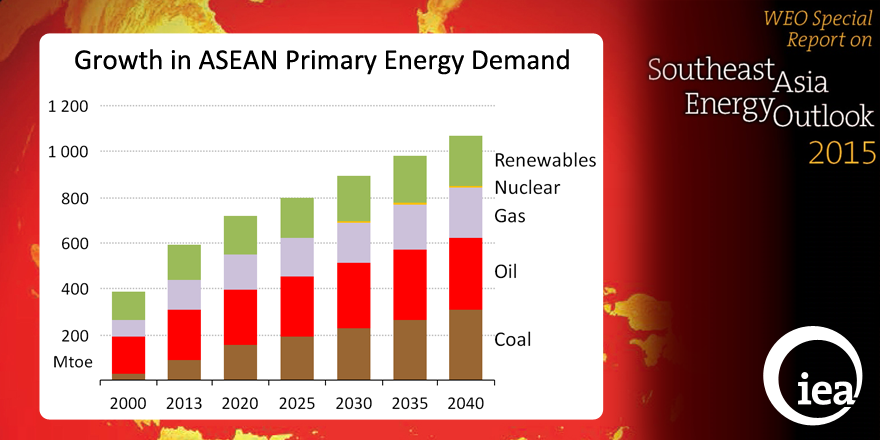
 The energy landscape in Southeast Asia continues to shift as rising demand, constrained domestic production and energy security concerns lead to a greater role for coal, a sharp rise in the region’s dependence on oil imports and the reversal of its role as a major gas supplier to international markets. 

Embedded image permalink

“As Southeast Asia flourishes, it is moving to the centre of the global energy stage,” IEA Executive Director Fatih Birol said. “Countries in the region now have much in common with IEA members. We must all work together to build more secure and sustainable energy supplies and markets, as platforms for promoting economic development.”

The World Energy Outlook Special Report on Southeast Asia (WEO Special Report) presents a central scenario in which Southeast Asia’s energy demand increases by 80% in the period to 2040, though the region’s per-capita energy use remains well below the global average. Despite policies aimed at scaling up the deployment of renewable resources, the share of fossil fuels in the region’s energy mix increases to around 80% by 2040, in stark contrast to the declining trend seen in many parts of the world.

Rising imports sharpen the focus on the economic and security aspects of energy use. By 2040 the region’s net oil imports more than double to 6.7 mb/d, a level equivalent to the current oil imports of China. Southeast Asia’s oil import bill surges to over $300 billion per year by 2040, compared with around $120 billion in 2014, with increases in spending in almost all countries in the region.

Indonesia supports a continued expansion of Southeast Asia’s gas and coal output, but production is increasingly consumed within the region. As domestic natural gas demand outpaces indigenous production, intra-regional and intra-country trade increases, and Southeast Asia turns into a net gas importer of around 10 bcm by 2040, compared with net exports of 54 bcm in 2013.

The power sector shapes the energy outlook for Southeast Asia, as electricity demand almost triples by 2040, an increase greater than the current power output of Japan. The sector continues its shift towards coal due to its abundance and relative affordability. Although the average efficiency of Southeast Asia’s coal-fired power plant fleet increases by 5 percentage points throughout the projection period, less-efficient subcritical technologies account for 50% of the region’s coal power fleet in 2040, highlighting the need to accelerate the deployment of more efficient technologies in the region to reduce local pollution and slow the rise in CO2 emissions. 

Wednesday, 14 October 2015

CARBON DIOXIDE - THE BENEFITS

This new report is a breath of fresh air. Instead of demonising carbon dioxide it lists the benefits of the extra CO2 in our atmosphere. Do look at it and wonder at the miracle of CO2. Far from being "pollution" it is actually the gas of life.

Tuesday, 13 October 2015

BBC TAKEN TO TASK IN LETTER FROM MP

The BBC has been challenged in a letter from Peter Lilley MP in which he criticises the BBC for apologising over a programme in which the Met Office was criticised. The programme was entitled "What is the Point of the Met Office" and is intended to be a light-hearted look at some of the countries major institutions. It will be interesting to see what sort of response the MP gets.

Monday, 12 October 2015

JUDGES PLOT TO OUTLAW CLIMATE CHANGE DENIAL

Christopher Booker discusses the implications of the top UK Judges conference in which they laid out their plans to force climate change policies on nations and corporations. It is both surreal and spooky. Let's hope it is also far-fetched nonsense.

Sunday, 11 October 2015

PETER FOSTER - PARIS'S SCARY CLIMATE AGENDA

 Financial Post, 7 October 2015
 In a speech last week, Pope Mark claimed that “climate change will threaten financial resilience and longer term prosperity.” But the primary threat comes not from climate change, but from climate change policy.
 

Details of two international agreements were released on Monday. One, the Trans-Pacific Partnership, which reduces trade barriers between 12 signatories, including Canada, got lots of ink. The other, which purports to control global weather, end the era of fossil fuels, and place all human activity under bureaucratic control, got very little.

Excerpts from a “Draft Agreement” and “Draft Decision” released Monday, Oct. 5, by the Ad Hoc Working Group on the Durban Platform for Enhanced a_ction under the United Nations Framework Convention on Climate Change, to be used as a the basis for negotiation of the draft Paris climate package.

The pretensions of the latter text, released by the Ad Hoc Working Group on the Durban Platform for Enhanced Action, ADP, which is assigned to come up with an agreement to put to the vast UN climate meeting in Paris in December, are mind-boggling. The fact that they attracted little attention means either that the media and public have no idea of the climate agenda’s implications, or that nobody takes the agenda seriously. Probably both. After all, the UN has been promoting the “urgent threat of climate change” for more than 25 years.

While the text of the TPP has yet to be finalized, that of the Paris meeting is skeletal. But, like skeletons, it is scary.

If anybody doubts the significance of the changes to which the puppeteers of Paris aspire, they should refer to remarks made last week by Mark Carney, the Governor of the Bank of England, who suggested that the climate thrust could destroy massive value as oil and gas assets are “stranded” by climate legislation.

Carney, former Governor of the Bank of Canada, has been lauded by segments of the Canadian mainstream media as a “rock star.” Indeed, he does bear some similarity – at least in orientation — to icon Neil Young, who has become deranged over the oil sands and recently signed his name to Naomi Klein’s loopy Leap Manifesto.

Carney would perhaps see his status as more analogous to another anti-capitalist crusader, Pope Francis, the man who put the “vestment” in “divestment.”

In fact, this is not the first time that Carney has addressed the risk of stranded assets. After a similar Bank of England claim earlier this year, Carney gave evidence before a House of Lords committee. Nigel Lawson, the redoubtable former Chancellor of the Exchequer and founder of skeptical think tank the Global Warming Policy Foundation, noted that the bank’s projections were entirely at odds with those of the International Energy Agency, which saw decades of fossil-fuelled growth. Lawson suggested that Carney should stick to his financial mandate, and that the Bank should stop spouting “green claptrap.” (Significantly, the draft Paris text cites “financial institutions” as key partners in its fight against capitalism. Meanwhile Carney isn’t just boss of the Old Lady of Threadneedle Street, he is head of the Financial Stability Board, a global organization of central bankers. He is reportedly to push the climate agenda at a G20 meeting in November).

The Paris text’s most significant feature is its lack of detail. It starts with the suggestion that the parties recognize “the intrinsic relationship between climate change, poverty eradication and sustainable development.”

But although the relationship may be intrinsic, it is far from clear. Insofar as the promoters of the agreement seek to starve poor countries of financing for “maladaptive” fossil fuel development, they are promoting poverty. Developing countries want nothing to do with having wind and solar foisted on them. They are gung ho for coal. They are also interested in the annual US$100 billion of handouts, starting in 2020, that was promised six years ago at Copenhagen but that, true to form, has not materialized.

The negotiating text betrays that peculiarly UN mindset that demands that all the world’s alleged problems be shouldered and addressed together, a kind of Gethsemane Syndrome. Not only will a giant interlinked series of new bureaucracies oversee programmes to regulate the climate and encourage appropriate technology and development to end poverty. They will negotiate these joint wonders while ensuring sensitivity to women, natives and the disabled. Their call to action claims to be based on “the best available scientific knowledge,” yet it also incorporates “traditional” — that is, distinctly non-scientific — knowledge.

Among additional “preambular paragraphs” being considered is a reference to “Mother Earth.” This is not just a spiritual add-on. As a provider of “environmental services” Gaia needs to be paid. Since she has no bank account, the UN is more than prepared to act as her proxy.

The document is a compendium of parentheses, that is, wording or issues that have yet to be decided. One parenthesis suggests that the famous 2 degrees Celsius rise in global temperatures (since before the Industrial Revolution) that will put us at an existential tipping point might be changed to 1.5 degrees Celsius. Could that be a recognition of the inconvenient fact that global temperatures are refusing to rise despite unprecedented increases in the CO2 that is meant to drive them?

The desperation to negotiate a deal is obvious in provisions that signatories may be able to pull out after three years, and that there are no penalties for non-compliance.

The document is very big on “capacity building,” which means bureaucrats teaching people to think like them, in terms of “modalities and procedures” and “facilitative dialogues.” Best practices are a top priority, particularly if they are “scalable and replicable.” Needless to say, the world’s most obscure document is big on transparency.

In that speech last week, Pope Mark claimed that “climate change will threaten financial resilience and longer term prosperity.” But the primary threat comes not from climate change, but from climate change policy.

The Paris text several times stresses the critical importance of cities and non-governmental organizations in promoting the climate agenda. Thus, to the extent that Canadian export pipelines are being opposed by local authorities in Vancouver and Montreal, and challenged legally and illegally by the likes of Greenpeace and ForestEthics, the UN’s agenda isn’t just bureaucratic fantasy. It’s a real threat to prosperity and democracy.

Saturday, 10 October 2015

LIMPING TO PARIS - NEW DRAFT CLIMATE TEXT IS 20 PAGES OF FUDGE

The American Interest, 5 October 2015

At long last, negotiators have hammered out a condensed draft text for this December’s climate summit in Paris. Members of the UN’s catchily named Ad Hoc Working Group on the Durban Platform for Enhanced Action took a bloated 86 page document and slimmed it down considerably. But a quick reading of the text evinces the fact that brevity and clarity are not the same thing, as plenty of uncertainty remains in the form of bracketed verbiage.

Here’s a sample of the first heading under the Mitigation section of the text, which is sure to be one of the most contentious items under discussion during the conference:
 
Parties aim to reach by [X date] [a peaking of global greenhouse gas emissions][zero net greenhouse gas emissions][a X per cent reduction in global greenhouse gas emissions][global low-carbon transformation][global low-emission transformation][carbon neutrality][climate neutrality]. […]
 Each Party’s nationally determined mitigation [contribution][commitment][other] [shall][should][other] reflect a progression beyond its previous efforts, noting that those Parties that have previously communicated economy-wide efforts should continue to do so in a manner that is progressively more ambitious and that all Parties should aim to do so over time. Each mitigation [contribution][commitment][other] [shall][should][other] reflect the Party’s highest possible ambition, in light of its national circumstances, and: (a) [Be quantified or quantifiable;] (b) [Be unconditional, at least in part;] (c) [Other].

To take one example, the difference between the words “shall” and “should” in an international treaty is obviously enormous, the former being presumably binding while the latter describes a suggestion for the involved parties. It’s not surprising that these differences haven’t been ironed out yet—that’s a job for the delegates due to descend on Paris—but this draft text is lousy with these sorts of opportunities for equivocation.

And you can be sure that many countries will be pushing for those less stringent, bracketed options. Take India, which last week outlined its 
climate pledge, a pledge that essentially amounted to a promise to only triple its carbon emissions by 2030, a reduction from the seven-fold increase unfettered growth might otherwise produce. India has long insisted on its right to grow and as Reuters reports, it’s planning on doing that with the help of cheap, dirty coal:
 
India is opening a mine a month as it races to double coal output by 2020, putting the world’s third-largest polluter at the forefront of a pan-Asian dash to burn more of the dirty fossil fuel that environmentalists fear will upend international efforts to contain global warming. […]
 If India burns as much coal by 2020 as planned, its emissions could as much as double to 5.2 billion tonnes per annum – about a sixth of all the carbon dioxide released into the atmosphere last year – [said  Glen Peters at the Center for International Climate and Environmental Research]…He said India could replace the United States as the world’s second largest emitter by 2025. “This is something no one would have expected.”

India isn’t the only nation keen on choosing development over green goals. Coal-dependent Poland has already 
staked out a similar position, and that sentiment will be forcefully expressed by many of the world’s poorer countries in Paris. The summit may have a shorter text, but if the new draft has accomplished anything, it’s to throw into sharper relief the divide between the developed and developing worlds.

Friday, 9 October 2015

JUDGES WINED AND DINED BY THE UN

Here are the details. Clearly if climate change treaties are to be enforced it is important for judges to be on-side, and this is helped by funding lavish conferences and making suggestions that highly-paid jobs are on offer to those who make the right noises. Here is what is going on. Make no mistake, the UN is a very powerful organisation and few governments are going to stand up to it.


Thursday, 8 October 2015

INDIA'S CLIMATE PLAN - TRIPLE EMISSIONS BY 2030

Read all the figures here. This is the reality as we approach the seminal climate conference in December 2015 in Paris. How on earth can the world's CO2 emissions be reduced or an agreement reached when faced with the reality of these figures from India. It is a complete nonsense, but as long as the public here in the West can be lead to believe that the result is a "success" then this fiction will continue. This will only happen with a compliant media. We will just have to wait and see if it can be done.


Wednesday, 7 October 2015

OPEN LETTER TO THE G20

Here is a link to the thoroughly argued letter which has numerous references linked underneath it. The letter calls for a halt to the building of wind farms because of the destruction to wild life and the fact that they actually prevent hardly any CO2 emissions at all, among a whole list of other good arguments.


Tuesday, 6 October 2015

WHOSE SIDE ARE YOU ON (IN THE GLOBAL WARMING DEBATE)?

This article looks at the quasi-religious nature of the global warming debate, particularly in the universities, and how everyone is forced to declare their allegiance to the cause or become an outcast. There is no reason to be discussed here, it is a religion, a very intolerant and fundamentalist one at that.


Monday, 5 October 2015

FIXING THE DIESEL EMISSIONS PROBLEM IS NOT EASY

This article gives a good account of the problem. Basically there is no technology available to do it (or else they would not have needed to cheat in the first place). Any thing which reduces the pollutants will adversely affect the power and the fuel economy.

For those who think that cheating on such a vast scale could not happen this should be a wake up call. I do not need to remind readers of this blog that there are many allegations of cheating such as this, this, this, this, this. I could go on, but you get the picture!


Sunday, 4 October 2015

DATA FIDDLING IN AUSTRALIA - QUESTIONS STILL GO UNANSWERED

This article explains what is happening. Cover up seems to be the government's answer, but will they be able to brazen it out? Sadly, they probably will due to a complicit, feeble media only too ready to keep in with the people with power.

Saturday, 3 October 2015

DOMINIC LAWSON: CLIMATE SAVIOURS & EUROPE'S MAD RUSH FOR DIESEL

The Sunday Times, 27 September 2015

The “rush for diesel” might seem an unmatchably counterproductive idiocy on the part of the EU member states, as they sought to prove themselves the saviours of the earth. In fact, it is merely one of a number of catastrophic components in the climate-change policy makers’ hall of infamy.


The inability to deal with the crises afflicting the European Union — a malfunctioning common currency and apparently unstoppable migration via the Mediterranean — is blamed by the European Commission on member states failing to act as one.

Yet unity behind a terrible policy is worse than any disagreement: and in no cause has the EU been more destructively united than in the battle against the alleged existential threat to the planet known as climate change.

While America and the developing world refused to sign up to the 1997 Kyoto treaty setting strict targets for reducing CO2 emissions, the nations of Europe, co-ordinated from Brussels, signed without a whisper of dissent. Britain was especially enthusiastic, in a vain delusion that we should achieve “global leadership” in the fight to “save the planet”.

It was idiotic to suppose that even eliminating all of the UK’s 1.5% contribution to worldwide CO2 emissions would achieve anything more than to de-industrialise the nation that started the Industrial Revolution.

Only the latest example is that the UK’s last large-scale steel-making plant, employing 3,000 at Redcar, is having to call on the government to save it from imminent closure. It can no longer compete with plants in countries that do not impose arbitrary CO2 emission limits on its steel manufacturers.

Redcar’s unaffordably high fuel bills are the direct effect of government policy demanding that the plant obtains a portion of its power from “renewables”. The result is not a global reduction of emissions: it merely moves their generation from here to another country, such as China. This is technically known as “carbon leakage”. National death wish is an alternative term.

The same, quite literally, has been the result of Europe’s concerted push to get its populations to abandon petrol for diesel as the fuel to power their cars. This is the real story behind the astonishing scandal of VW’s fraud upon the US Environmental Protection Agency. VW had installed software in its newer diesel cars that detected when the vehicles were being tested for noxious emissions and cut most of the smog-forming compounds caused by burning diesel.

When the cars were driven normally on the road by owners, the software “defeated” the pollution control. This greatly enhanced the vehicles’ performance. And so VW could claim — absolutely dishonestly — that it was selling high-performing diesel cars while conforming to stringent American “clean air” requirements.

Yes: America, frequently accused by Europeans of being a laggard in environmental protection, has stricter regulations governing air pollution than the eternally preachy EU. This is because of — and not despite — Europe’s obsession with climate change.

Our government, after its signing of the Kyoto treaty, set up an incentive through vehicle excise duty to push consumers into buying diesel rather than petrol cars. The point is that diesel produces more oomph per gallon than petrol, so less of it is used for each mile’s driving and hence less CO2 is emitted in the course of any given journey.

However, it has always been known that burning diesel creates much more of the oxides of nitrogen that can cause terrible damage to the human respiratory system: more than 20 times as much of the stuff as burning petrol does. Because in America engine emission controls are related much more to overall air quality than in the EU, VW had a real problem getting its diesel cars into that market. Hence its scam.

Yet here the national obsession — at least in Whitehall — with CO2 means that British lives have been shortened to save future lives in Africa (the continent thought to be most vulnerable to the consequences of climate change). The developing world, meanwhile, is cracking on with fossil-fuel power generation, since its leaders understand that that is the fastest way to lift their countries out of poverty — and really save lives.

By the way, do not listen to politicians such as the shadow energy and climate-change minister Barry Gardiner, who said this year of the decision to go all out for diesel: “Hands up — there’s absolutely no question that the decision we [Labour] took was the wrong decision. But at the time we didn’t have the evidence that subsequently we did have.” A senior Department for Transport civil servant recently admitted: “We did not sleepwalk into this. To be totally reductionist, you are talking about killing people today rather than saving lives tomorrow.
Occasionally we had to say we were living in a different world and everyone had to swallow hard.”

That is, the different world of politicians and campaigners who had convinced themselves that the only environmental policy that mattered was reducing carbon emissions. That meant regarding CO2 as a greater public enemy than poisonous fumes. Taken to its logical conclusion, this would classify mouth-to-mouth resuscitation as more dangerous than inhaling particulates from the back of a London taxi, a vehicle that is crazily regarded as better for the planet than the petrol- powered cabs on the streets of American cities. Londoners may choke but we’re saving the Earth. Except that Gaia shows every sign of being able to cope just fine with man’s CO2 emissions.

The “rush for diesel” might seem an unmatchably counterproductive idiocy on the part of the EU member states, as they sought to prove themselves the saviours of the earth. In fact, it is merely one of a number of catastrophic components in the climate-change policy makers’ hall of infamy.

There was the EU’s directive mandating that 10% of energy in transport come from “biofuels” — that is, crops. In this case the US was complicit in the lunacy, although for different reasons: it subsidised ethanol production — fuel from corn — because it wanted to reduce its dependence on Middle Eastern oil.

The result was a drastic increase in global food prices that was felt most acutely by the poorest people on the planet: it was for this reason that a United Nations special rapporteur on “the right to food” said the EU’s biofuels policy was “a crime against humanity”.

Perhaps the craziest policy of all was that derived from Kyoto’s “clean development mechanism”. Under it, signatories to the treaty could gain emission reduction credits by paying poorer countries to reduce their production of gases including HFC23, a by-product of the manufacture of refrigerants thousands of times more potent than CO2 in creating the greenhouse effect.

As a Global Warming Policy Foundation pamphlet, The Unintended Consequences of Climate Change Policy, said: “The upshot of this influx of western money was to completely change the b_ehaviour of refrigerant manufacturers. Instead of HFC23 being merely a by-product of the manufacturing process, it came to represent their principal product. The factories were in effect being incentivised to produce this most powerful of greenhouse gases.”

Nowhere more so than in China. It was an echo of what happened when the Communist party under Mao Tse-tung rewarded citizens who slaughtered the most houseflies: people began breeding them so as to produce the necessary number of dead flies to gain the reward. This is the lunacy that can happen when central planners issue what they call “incentives”. It doesn’t help, admittedly, when the original policy is insane.

Friday, 2 October 2015

CLIMATE CHANGE AND THE MYTH OF STRANDED ASSETS (MARK CARNEY TAKE NOTE)

By Nick ButlerFinancial Times, 28 September 2015

The energy business is entirely familiar with the concept of stranded assets. Now, however, a new concept has been introduced: the idea that some assets, specifically hydrocarbons, will inevitably be stranded and left undeveloped as the world reduces its hydrocarbon consumption in order to avoid the risks of climate change. The question is whether investors and companies should be worried by that concept.

Across the world all sorts of resources are well identified but cannot be developed. They range from the gas underneath the Prudhoe Bay oil field in Alaska to the coal under North Yorkshire to the large reserves of shale oil in the Paris Basin. All these assets are stranded because of the costs of development, including in some cases regulatory costs imposed in pursuit of public policy goals. In the case of French shale oil and gas, all activity is banned. In some cases, people are working to find a way of bringing the resources to market. In others the only option is to give up and leave them buried.

The new concept, which was the subject of a conference in Oxford last week under the auspices of the Smith School of Enterprise and the Environment, introduces the idea that the category of stranded assets is about to be expanded dramatically as the world adjusts to limiting hydrocarbon use to levels that ensures global temperatures rise by no more than 2C. The level of danger is disputed, as is the precise amount of hydrocarbons that can be safely used — but the differences do not alter the basic thrust of the concept.

If the concept is correct, the amount of coal, oil and natural gas that can be safely used has already been discovered. Over time, through a mixture of fiscal and regulatory moves, hydrocarbons will be priced out of the market. On this analysis exploration is valueless, as are some of the resources already identified. The rest should stay buried and cannot be valued as corporate assets.

Is this logic correct? The debate is important, not just for energy policy but also for investors, because the implication is that the hydrocarbon-based businesses are entering their final decades and will soon cease to be viable as ongoing concerns. If you accept the thesis, unless the owners can swiftly produce the assets they hold, they are also overvalued.

Step back from the emotion of the debate on climate change and it is clear that this logic is correct onlyif you believe the three assumptions on which it is based.

The first is that the use of hydrocarbons will be limited by public policy action to keep total emissions within the prescribed limit.

The second is that alternative energy supplies will be available in time and at a low enough cost to enable consumers to switch away from hydrocarbons.

The third is that attempts to reduce the amount of emissions generated by the use of hydrocarbons – such as carbon capture and storage (CCS) – will not be viable on the scale required to allow continued hydrocarbon consumption.

I think most observers on all sides of the debate would now reluctantly agree that the third assumption is correct. As reported by Pilita Clark in the FT recently, current CCS projects are limited and minimal, and no clear financial model has been put in place to encourage companies to invest. The decision not to proceed with the scheme planned at Drax in the north of England last week just confirms what most observers have long believed. Most current CCS is economic only because the activity supports enhanced oil recovery. Things may change; but as things stand CCS will not make a major difference.

When it comes to the second assumption, the judgment is less certain. Low carbon energy costs are falling (other than for new nuclear, where they are rising). Solar costs have come down dramatically. There are advances in storage technology – which would transform the economics of renewables that produce only intermittently such as solar and wind – but the big breakthroughs are still the stuff of hope rather than reality.

At the moment low-carbon sources of supply, including nuclear and hydro, provide less than 10 per cent of global total energy supply. By 2040 on the International Energy Agency’s new policies scenario, which is moderately optimistic about action on climate change, they still provide only 15 per cent. One day there should be a major technical breakthrough. But until then we cannot assume that any form of renewable supply is going to displace coal, oil and natural gas. Most long-term forecasts show that renewables will produce growing volumes of energy over the next 20 or 30 years but so will hydrocarbons. Both grow in a world where, even with improving efficiency, total consumption keeps rising.

That takes us back to the first assumption: that the use of hydrocarbons will be limited by public policy to keep emissions below 450 parts per million, which is the normally quoted level of safety.

I believe that assumption is completely unrealistic. It is possible that Europe and the US will limit hydrocarbon use in one way or another, though that judgment is crucially dependent on the development of a political consensus in the US that does not yet exist. President Barack Obama’s climate measures could well be overturned by a Republican victory in next November’s election.

European policy arguably carries a degree of consensus support but that support has not yet been sufficient to put in place the crucial policy measure – a carbon price.

China will also take steps to limit the use of coal but, with a growing economy, it is very hard to see coal being displaced as the main source of energy supply at any point in the next three decades. Coal plants continue to be built, and only a minority have the super-critical technology that minimises emissions.

Other growing economies such as India remain committed to coal, which is cheap and readily available. There is at present no obvious alternative source of energy for the tens of millions of Indians struggling to emerge from poverty. They cannot afford to pay a high carbon price.

This is a fairly dismal conclusion but when it comes to something as potentially serious as climate change it is best to be absolutely realistic. Campaigns about disinvestment create convenient enemies but solve nothing. The logic is that, to meet the growing energy needs of people with very limited financial resources without taking unacceptable risks with the climate, we have to find a technology that is both low cost and low carbon. When it comes, that will leave some assets stranded or put to other uses. The search for that low-cost low carbon solution should be the real focus of attention for campaigners, governments and investors.

Thursday, 1 October 2015

THE SUPPRESSION OF (CLIMATE) SCIENCE

Here is an interesting and disturbing article by a former NOAA meteorologist that ought to concern anyone who believes science should be free to allow scientists to seek the truth wherever it takes them. This article comes from the No Tricks Zone website (link on the side-bar) which takes a special interest in German articles on global warming, and is well worth a read.


Wednesday, 30 September 2015

MARK CARNEY SHOULD LOOK AT THE FACTS ON INSURANCE AND CLIMATE CHANGE


This article by Roger Pielke should be compulsory reading for the Bank of England chief who yesterday gave a speech more appropriate for a climate change activist than for a sober bank chief.

INDIAN PM PLAYS THE "CLIMATE JUSTICE" CARD

In other words he wants the developed nations to compensate India and all other developing nations as well as cutting emissions, while India can go on emitting as much CO2 as it likes. I hope that the developed world's leaders are not as stupid as the Indian PM thinks, but reading some reports I fear that Obama and the EU leaders may fall for this nonsense. The fact is that it is future emissions of CO2 that are being blamed for future warming that are claimed to cause the alleged problem, so discussing past emissions is pointless. Either the Indian leadership are fools or they are playing us for fools. At the present time there has been only 0.8 degrees C of warming and this cannot be attributed to any catastrophic change in climate. Read what the Indian PM says here.

Tuesday, 29 September 2015

LAW PROFESSOR WANTS UN JUDGES TO RULE ON CLIMATE SCIENCE

Could the scientific arguments on global warming be decided by judges who may not be experts in the area of study that they are ruling on? It is an interesting idea. The nearest I can recall it happening was here, though that case was on a much narrower point. My fear is that it would be very difficult to find a judge or judges that were truly neutral. Whichever side lost would immediately claim the judge was biased. Just reading the case here gives a flavour of what would be expected. I would like to see the two cases put in a public arena. Perhaps instead of a judge we need to have a well educated jury chosen at random.


Monday, 28 September 2015

EU ECONOMY LOOKS MORE AMD MORE LIKE THE OLD SOVIET ONE

This post from the very sound MEP, Roger Helmer, (now of UKIP) has it exactly right. The EU is bringing in more and more regulations to try and lessen the damage that their current regulations are doing and each time they merely increase complexity and confusion. The result is that energy intensive businesses are either folding or moving out. When will the political leaders wake up? Let's hope that UK voters wake up and choose to quit this old-fashioned, left-wing organisation while we can.

Sunday, 27 September 2015

CARBON (DIOXIDE) CAPTURE AND STORAGE BITES THE DUST

This article explains how a UK energy company is pulling out of a project on CCS, citing fear of government's lack of support. As the government is waking up to reality, so the private sector is deserting the field as they realise that the subsidies are simply not going to be there. Is this a sign that the Grand Folly is coming to an end? Possibly, but don't hold your breath!

Saturday, 26 September 2015

WHY NICHOLAS STERN IS WRONG ON CLIMATE CHANGE

Here is a good article criticising the economist, Nicholas Stern's new book urging urgent action on climate change. Stern has been far too influential in this debate, considering that he is so wrong. This article should be essential reading for those politicians who have paid homage to Stern. He has been debunked many times, but it is good to see it done again in a readable and compelling way.

Friday, 25 September 2015

WILL OBAMA SIGN A CLIMATE TREATY IN PARIS WITHOUT SENATE APPROVAL?

That is what commentators are saying he will do, but whether he can get away with it is another story. For a detailed look at the situation read this report.


Thursday, 24 September 2015

VW EMISSIONS FIASCO - WAS CUTTING CO2 PUT ABOVE EMISSIONS HARMFUL TO HEALTH?

Amid all the reporting of Volkswagen’s rigging of emission tests on its diesel cars, one
inconvenient truth has been overlooked by the BBC and many media organisations. It is that we very largely owe the prevalence of these death-traps to the pernicious tyranny of the Green lobby. In their deafness to different points of view — in fact, in their rank intolerance of opposing voices — these people often remind me of religious fundamentalists. They shout down, or seek to censor, those who don’t agree with them. The pity is that mainstream media such as the all-powerful BBC are themselves cowed and meekly quiescent, so that a highly intelligent and well-informed climate-change sceptic such as the former Tory Chancellor Nigel Lawson is virtually excluded from the airwaves. Volkswagen has emerged from this story as a devious and untrustworthy conglomerate. But the biggest lesson of this debacle is that successive British governments have sacrificed the interests of ordinary citizens as they have caved in to the demands of a dangerous bunch of zealots. --Stephen Glover, Daily Mail, 24 September 2015

Tuesday, 22 September 2015

ARCTIC ICE MELTING PAUSE CONTINUES FOR 9TH YEAR

This article explains that the ice melt in the Arctic Ocean has been more or less stable for nine years and yet some climate alarmists are pretending that this is not so. This is rather similar to those denying the pause in global warming. So, who are the deniers now?

Monday, 21 September 2015

ARCTIC ICE - THE LATEST PICTURE

This piece looks at how this year is working out compared with other recent seasons. Humans have only been able to study the Arctic ice for around 35 years, which is lie the blink of an eye compared to the history of the climate. We simply don't know enough to be able to say whether the Arctic is undergoing an unusual change or simply part of a natural cycle. 

Sunday, 20 September 2015

MET OFFICE CHIEF IN NEPOTISM ROW

This article gives the details of how Julia Slingo's daughter managed to land a job at the Met Office just at the time her mother was appointed as Chief Scientist.  Looks a bit fishy, but the worst aspect is that the Met Office seem to be chief propagandists for the AGW hypothesis.

Saturday, 19 September 2015

ALARMIST CLIMATE SCIENTISTS PLEA FOR SCEPTICS TO BE SILENCED BY LAW

This article shows how desperate some of theses climate scientists have become to silence those who disagree with them.


Friday, 18 September 2015

THE CLIMATE CHANGE INDUSTRY IN THE UK

People talk of a "climate change industry". Below is an example which was sent to me. It is surprising that people and organisations are prepared to fork out up to £300 for what is in effect completely pointless, given that there has been no noticeable change in the UK climate during the past century. How much longer can this nonsense keep going?


Climate Change Conference London 21st December 2015:
The next ‘Planning for Climate Change’ Conferences will be held on the 21st December 2015 in London and on the 28th October 2015 in Dublin. Details can be found here and details of the current speaker line up can be found here for London and here for Dublin.   Details can also be found on Facebook& Twitter.   The key focus of both days is to debate and discuss the key issues that face communities, economies and society when it comes to adapting to climate change and addressing the problems and opportunities that climate change brings.  We plan to have up to 30 speakers plus up to 150 delegates on the day.   To register as a delegate, or a speaker please access the registration page or email your requirements  to be a delegate or with your proposal for a speaking slot hereThe cost to attend as a delegate and/or speaker for either conference is as follows:
Delegate and/or Speaker full rate: £250 plus VAT (total of £300).
Reduced rate for students/researchers Delegate and/or Speaker: £125 plus VAT (total of £150).
Climate Change Journal Launch London 21st December 2015:
At the Planning for Climate Change Conference we will be launching a new academic, policy and research Journal called the Journal of Planning for Climate Change.  This Journal will be a focus point to promote and share research and good practice on how we plan and adapt to the challenges that we face from increasing climate change.  We welcome contributions from anyone who has an interest in this area of policy and we welcome anyone who would like to be a member of the Journal Editorial Board.  If you want to submit a paper for publication please email here. To subscribe to the Journal please visit the subscription page or email here.  Details of the Journal Editorial and Submission Guidance can be found here.

Thursday, 17 September 2015

IF THIS ISN'T POLITICAL ACTIVITY IN SCHOOLS THEN WHAT IS?

Here is another "climate change lesson" by Oxfam. It clearly includes inciting children to take part in political campaigning, and yet Oxfam is a charity and this isn't supposed to be allowed.


Wednesday, 16 September 2015

ALARMIST USES SHOCKING IMAGERY IN NY TIMES ARTICLE

 Timothy Snyder has written this in a desperate attempt to shock readers into believing in the hypothesis of man-made catastrophic global warming (when none has taken place). While some may be suitably shocked into supporting the "cause", quite a lot will see this for the cynical ploy that it is and conclude that it is simply unacceptable. In what way is it acceptable to suggest that somehow man-made climate change will cause a new holocaust? This is just pathetic and desperate.


Tuesday, 15 September 2015

SOMETHING STRANGE IS HAPPENING IN THE NORTH PACIFIC

Here is the article explaining what is happening. I have not seen this on the news, though it should be. Perhaps it does not fit in with global warming.

Monday, 14 September 2015

UK TO NAME EXTREME WEATHER EVENTS - I NAME THAT BREEZE "BRIAN"

This piece correctly points out how mild our weather generally is, and even our "extreme" weather is mild by global comparison. I wonder why the Met Office has taken this action? Could they be trying to convince us that our weather is becoming more extreme?


Sunday, 13 September 2015

BASIC ERRORS IN SCHOOL CURRICULUM BY OXFAM

Here is a sample of the work given by Oxfam to school children in the UK. It is strewn with basic errors (described as "simplification") which make it, in effect, propaganda which should have no place in schools. If this sort of stuff is being taught in schools at any level, then it breaches the guidelines of political impartiality and needs to be investigated. No where could I see any balance, such as giving students the beneficial effects of putting some extra CO2 in the atmosphere. There was no mention of the pause in warming for the past 18 years.

Update - The most basic error in their literature is to show children a glass jar and claim that this acts like CO2 gas by "trapping heat" as in the so-called "greenhouse effect". This is completely wrong as the mechanism by which the jar traps heat is by preventing convection from dispersing the warm air. This is deliberately not taught, and so it is a false idea implanted in the children's mind. Only the brightest child is likely to spot this - though if he did then the teacher would have to admit the analogy is false, undermining the point of the experiment in the context of atmospheric warming. As far as science teaching is concerned, this subject is far too difficult for children aged 7 to 11 to understand and were it not for the political aspect Oxfam would not be interested in pushing it into schools at all. We might as well try to teach them nuclear fission.

Look at Activity 1.3 and in particular the diagram with all the "ideas" posted on it. Not one item is "off message" suggesting complete agreement among all the students who are obviously simply parroting back what they have been told. I wonder what would happen if a child put something "off message" on to the chart? It's time for the child to tell the emperor that he has no clothes.


Saturday, 12 September 2015

SCHOOL PROPAGANDA STRAIGHT FROM OXFAM

This link shows what is being done, paid for by the taxpayer. Young children are being indoctrinated right here in the UK.

Here is what Oxfam is doing in Australia.

Friday, 11 September 2015

SOUTHERN OCEAN SINK WORKING FINE SAYS NEW STUDY

Southern Ocean ‘Sink’ Turns The Tide On Climate AlarmThe Australian, 11 September 2015

Graham Lloyd
 
The Southern Ocean has recovered its ability to suck vast amounts of carbon dioxide from the atmosphere, overturning fears the natural “sink” had stalled with dire consequences for future climate change.


Acting like a giant lung, the Southern Ocean carbon sink accounts for about 40 per cent of the ocean uptake of anthro­pogenic carbon dioxide.

Climate scientists had feared the uptake of carbon dioxide by the Southern Ocean had slowed in what was feared to be a “feedback” response to human ­activity.

New research published today in the journal Science reveals that rather than stalling, the amount of CO2 being ­absorbed by the Southern Ocean was on the rise again.

It is thought that changes in weather — particularly wind patterns and temperature in the Pacific and Atlantic oceans — were responsible.

The findings have invigorated debate about how well scientists understand the natural variations in the earth’s climate.

Lead author Nicolas Gruber, from ETH Zurich, said the research did not address directly whether fluctuations in the sink strength were because of natural or human-induced variability.

“The starting hypothesis is that they are a result of natural variations,” Dr Gruber told The Australian.

Benny Peiser from the London-based Global Warming Policy Foundation said it was “not the first time that lengthier observations have led to the demise of a short-term climate scare”.

“The fact that researchers now acknowledge they cannot predict future trends indicates that they don’t fully understand the underlying physics and mechanisms,” Dr Peiser said.

Contributing author Dorothea Bakker, from the University of East Anglia, said the variation in the Southern Ocean carbon sink was larger than expected on the basis of the growth of atmospheric CO2 alone.

“The Southern Ocean behaves like a giant lung — breathing in and absorbing vast amounts of CO2 from the atmosphere, and releasing it later in the year,” Dr Bakker said.

“The seas around Antarctica absorb significantly more CO2 than they release. They basically help to slow down the growth of greenhouse gas in the atmosphere and lessen the rate of climate change.”

CSIRO Southern Ocean expert Steve Rintoul, who was not part of the research team, said the new analysis showed the strength of the Southern Ocean carbon sink varied with time more strongly than expected. “The weakening and strengthening of the Southern Ocean carbon sink reflects changes in ocean temperature and carbon dioxide driven by variations in the winds blowing on the ocean surface,” Dr Rintoul said.

He said the wind changes were caused by human activities such as greenhouse gases emissions and by natural variability. “The results show that overall, the Southern Ocean sink is keeping pace with the increase in atmospheric carbon dioxide. “This is in contrast to some earlier studies based on model experiments and atmospheric data that concluded the Southern Ocean carbon sink was weakening.”

GWPF science spokesman David Whitehouse said the recovery of the Southern Ocean carbon sink “could be yet another explanation for the surface temperature hiatus”.

He said the research was “another alarmist claim removed by science, showing that the ‘settled science’ isn’t settled at all.

“The fact is that the current models do not fit the observations, so there we have a vital part of future climate prediction shown to be not predictable,” Dr Whitehouse said.

“No one knows why the Southern Oceans are doing this, and no one can say what will happen next. It seems the Southern Ocean, along with a little bit of help from the sun, means that future climate projections, especially decadal ones, have become far more uncertain.

“The closer you look at widely held certainties, the more complex and less understood they become — that’s the science of a complicated earth.”

Thursday, 10 September 2015

UK POWER NETWORK PERILOUSLY CLOSE TO BLACKOUTS BY 2016 IF WIND DROPS

Picture a cold and dark wintery evening in November and millions of householders across the country are switching on their kettles at the same time after a long day at work but suddenly there is a big problem.

Another creaking coal-fired power station has been shut down and with barely a breeze blowing to fire up the thousands of wind turbines that Britain has increasingly relied upon to keep the lights turned on, the entire electricity network has become overloaded.

Suddenly, the doomsday scenario of a nationwide energy blackout and power curfews on a scale not seen since the bleak winter of enforced economic hardship of 1979 becomes reality.

This is the fear of experts like Anthony Price, director of Electricity Storage Network, who argues that policymakers have allowed the system to become too vulnerable to outages, which could cost the economy billions of pounds in lost output and productivity.

“As a society we run the risk of paying the price eventually for running everything with the very minimum of spare capacity available,” said Mr Price. “If something does go wrong with the existing generating system we really have no where to run to meet demand.”

His concerns were brought into sharper focus last week with the announcement that the Eggborough power station in Yorkshire would close in March 2016. The plant generates around 4pc of the UK’s electricity and its shutdown at the end of the winter will place a further squeeze on the safety cushion for avoiding a blackout across large areas of the country.

Conventional fossil-fuel burning power stations like Eggborough and the Longannet coal-fired plant in Fife that is also due to close in March are still the most reliable means to produce electricity for the grid, despite the dramatic shift over the last decade towards renewables such as wind or solar.
 

“Things are moving into uncharted territory in terms of security of supply,” said Peter Atherton, utilities equity analyst at Jefferies. “We have never had such a low ratio of conventional power plant capacity compared with renewables and the problem is going to get worse.”

The announcement in May by SSE that it would be closing the giant Ferrybridge power station in Yorkshire by March 2016 has also raised the stakes for regulators who are duty bound to ensure Britain has enough power. Based on the recent closures, power supply levels published by Ofgem show that Britain will be perilously close to blackouts by the winter of 2016 if wind levels prove to be too low to generate adequate electricity for the grid.

According to Mr Atherton the problem started with the Labour government under the former Prime Minister Tony Blair which committed Britain to unachievable targets for building renewable energy capacity.

The suspicion is that Mr Blair went into European climate talks in 2007 not even knowing the difference between energy – which covered everything from transportation to home insulation – and electricity. Almost a decade later, this possible schoolboy error by Mr Blair and his negotiating team could lead to blackouts for the “first time in living memory”, Mr Atherton believes.

“Germany and Spain for example don’t have the same security of supply problem as we do. We are unique in that we have a problem with supply and affordability of power,” he said.

The Coalition and the new Conservative Government have essentially continued along with the same unrealistic policy which has committed Britain to generating around 80pc of its power from renewables and nuclear by 2030. Another problem according to Mr Atherton is the need to build more latency into the renewable network.

He estimates that to replace 1 gigawatt of conventional coal or gas generated power capacity it requires the equivalent of around 3.5 gigawatts of renewables.

“The problem is that the closure programme for conventional plants like Eggborough is running to time but the new build programme is now about four years behind schedule. There is a big mismatch between what is getting shut down and what is getting built to replace it,” said Mr Atherton.

Wednesday, 9 September 2015

GREENPEACE THE EMPLOYER FROM HELL

This piece reveals the uncomfortable truth about this supposedly worker-friendly organisation which campaigns for so many left-wing causes, which is that they are as cut-throat as any other business and the bottom line is their number one priority. In fact they have become just another multi-national business.

Tuesday, 8 September 2015

GLOBAL WARMING IS ALL ABOUT OVERTHROWING CAPITALISM SAYS NAOMI KLEIN

This article looks at her recent book in which she explicitly admits that climate change is not about science at all, but it is about changing the world. Why on earth don't the Western political leaders wake up to this reality before they sign up to impoverish their citizens for a false prospectus?

More on this here.


Monday, 7 September 2015

POOR NATIONS STILL AFTER CLIMATE MONEY

This article looks at the proposition that the developed nations are somehow "responsible" for the damage caused now and in the recent past by their historic emissions of CO2. This seems to be a complete fiction because (a) temperatures have risen by such a small amount that this could not have made any difference to weather extremes and (b) there has been no increase in extreme weather events over the past hundred years of records. Despite the points just mentioned, as you will see in the linked article, our political leaders seem ready to concede that this historic responsibility is a reality and are about to concede billions of pounds to put it right.

Sunday, 6 September 2015

KATRINA - AFTER 10 YEARS WE CAN SEE HOW THIS EVENT WAS USED AS PROPAGANDA

Here is a good article which looks at the way hurricane Katrina was used to make a false case for the threat of increased hurricane activity in the Atlantic, blamed of course on increased CO2 emissions. Now a decade on we can see that this threat has not materialised. Hurricanes have always been a threat and remain so. Had there been an increase,  due to natural variation, they would have said "look, we told you so."


Saturday, 5 September 2015

FORMER METEOROLOGIST DISCLOSES YEARS OF CENSORSHIP ON NATURAL WEATHER CYCLES

This article gives the details of yet more evidence of manipulation of freedom of speech to hide any alternative to the man-made global warming mantra.

Friday, 4 September 2015

UK SUMMER - HOW DID THE MET OFFICE PREDICTIONS WORK OUT?

Here is an article which looks at the extraordinary way the Met Office shifts its position as their predictions start to unravel. Even their explanations for the weather are inconsistent. I think we all know that weather forecasting is extremely difficult, but by making out that they can do far more than they can they end up looking very foolish. It's time for them to come clean and admit that they know far less than they claim and stop the propaganda.

Thursday, 3 September 2015

OBAMA'S ALASKAN CLIMATE PROPAGANDA

This piece looks at the reality of what is actually happening to the climate in Kivali in Alaska where President Obama was seen on our news broadcasts yesterday telling us that there was a catstrophe going on due to sea level rise and increased storms and that this was all due to increases in CO2. Thanks to Paul Homewood we can see the true picture which is that the real cause of the climate change there is retreat of a glacier which has been going on for over 100 years. How strange that the President didn't mention it.

UPDATE Yet more data from Paul Homewood.


Wednesday, 2 September 2015

HOW THE WARMIST ARGUMENTS DON'T STACK UP

This article was written as a rebuttal of arguments put on an Australian TV programme that supposedly put both sides of the climate change debate, except that they didn't. Instead they deliberately put a very weak case for the climate sceptics and then went on to demolish it, in other words the programme was simply propaganda. The article is a brilliant tour de force by Jo Nova and is essential reading for anyone who wants to understand the weakness of the warmist case.


Tuesday, 1 September 2015

UK NORTH SEA OIL INDUSTRY HEADING FOR THE SCRAPHEAP

The Sunday Times, 23 August 2015

Danny Fortson
 
The North Sea stands out as one of the world’s most expensive places to operate. Most companies are now operating at a loss. A domino effect may mean that North Sea production will dwindle rapidly in a few years.


Sometimes one company perfectly captures the course of an industry. For the North Sea, that company is Fairfield Energy. Launched a decade ago with $200m from a clutch of savvy investors, led by American buyout firm Warburg Pincus, Fairfield’s plan was to scoop up old oil fields cast off by the industry giants and breathe new life into them.

In 2012 Riverstone, the energy specialist then run by Lord Browne of Madingley, ploughed in another $150m. The renowned former BP boss even joined the board, endorsing Fairfield’s strategy of squeezing the last drops from decades-old platforms whose output had slowed to a trickle.

Yet forces were gathering to dash the company’s plans. The offshore industry’s operating costs doubled in just five years as contractors used a buoyant crude price to ratchet up day rates for drilling rigs and boats. Unions won better salaries and shorter working hours.

The 60% drop in the oil price since last summer to $45 a barrel was the final nail in the coffin.

Rather than styling itself as a saviour of Britain’s oil industry, Fairfield has decided there is more money to be had from feasting on its carcass. Three months ago it took the first steps to transforming itself into a decommissioning specialist. Its old fields have been closed or put up for sale, and it has begun hiring experts to dismantle platforms.

David Peattie, the former BP high-flyer who was parachuted in just two years ago, will leave after a buyer is found for Fairfield’s one reservoir that is producing oil. Browne stepped down from the board this year and at the same time left Riverstone.

A Fairfield source said: “We were set up to put off decommissioning for 10 to 20 years. Now we’re doing the opposite. It’s quite amazing really.”

Fairfield’s transformation from saviour to undertaker is a stark example of the forces battering the industry. The North Sea was once the biggest single contributor to the exchequer, but this year it will hand over little more than £1bn, compared with more than £11.5bn just three years ago, according to the specialist adviser Hannon Westwood.

The Office for Budget Responsibility reckons that the Treasury’s take between 2020 and 2040 will dwindle to a total of just £2bn, a 94% reduction on previous forecasts.

The day when the North Sea goes from asset to liability is not as far away as one might think, not least because the taxpayer is on the hook for roughly 60% of the estimated £30bn decommissioning bill.

Indeed, next year a ship equipped with the world’s largest scissors will chop the top off the first of four platforms in the Brent field, about 110 miles east of the Shetland Islands. The reservoir, after which Britain’s benchmark crude is named, pumped an astonishing 4bn barrels before it was shut down in 2011. It will be the North Sea’s biggest decommissioning project yet. [...]

In the face of that collapse, the North Sea, where rig cooks can bring home £50,000 a year, stands out as one of the world’s most expensive places to operate. Most companies are now operating at a loss.

Only nine of the 120 companies in the North Sea are profitable and, thus, pay tax, according to Ian Norbury at Hannon Westwood. This will get worse.

So far this year only two new projects have been approved, against seven last year and ten in 2013. Exploration is on track to hit a record low, with as few as eight wells planned this year. “The cupboard is bare in terms of planned wells,” said Norbury.

Half a century after the founding of the North Sea industry, its biggest fields are mostly dried up. What remains is the crumbs that are not worth the time or investment of the biggest players.