Booker's latest article is warning of the looming cost of our electricity as the cuts in fossil fuel use continue to bite. although the Germans pay a lot more for their electricity currently than we do, we are catching up fast due to the ridiculous climate change act. The government must dump it soon.
Monday, 31 October 2016


Sunday, 30 October 2016
WHY DO FLOWERS COME OUT EARLIER THAN IN THE PAST?
This question is often raised as being evidence for global warming. There is clear evidence for it, but what is not clear is exactly why it is happening. This article looks at the issue in detail. In the comments several readers show links to articles on the urban heat island (UHI) effect as a possible cause, while others point to the fact that there has been a preponderance of milder winters in the UK in recent years (which are welcomed by most people). The article itself from the Royal Society shows on its graph that springs have been both warmer and cooler in the period studied, so there is no single trend.
Saturday, 29 October 2016
SCIENTIFIC NONSENSE AND THE PEER REVIEW LOTTERY
Here is a very disturbing article on the validity of "peer review" of scientific papers in which other scientists look at the work and pass judgment on it. It reveals a murky world in which some papers are rejected with no really valid reason while other papers of little or no merit can get passed. Yet it is this lottery that provides the evidence for costly political decisions such as those for global warming.
"In 1982, 12 already published papers were assigned fictitious author and institution names before being resubmitted to the same journal 18 to 32 months later. The duplication was noticed in three instances, but the remaining nine papers underwent review by two referees each. Only one paper was deemed worthy of seeing the light of day the second time it was examined by the same journal that had already published it." The whole article is well worth reading
"In 1982, 12 already published papers were assigned fictitious author and institution names before being resubmitted to the same journal 18 to 32 months later. The duplication was noticed in three instances, but the remaining nine papers underwent review by two referees each. Only one paper was deemed worthy of seeing the light of day the second time it was examined by the same journal that had already published it." The whole article is well worth reading
Friday, 28 October 2016
TOUR DE FORCE DEBUNK OF GW SCAREMONGERING
This piece is a thorough debunking of pretty much all the nonsense on GW that you are likely to meet. It is so useful that I have put it at the top of the link list on the RHS of this blog as a reference point.
Thursday, 27 October 2016
THERE IS NO "HOTSPOT" AND THEREFORE THE GW THEORY IS DISPROVED
This article presents the case clearly and concisely. This evidence has been ignored by the mainstream media, but it needs to be distributed widely via the internet.
Wednesday, 26 October 2016
DODGY DATA FROM NOAA USED TO BOLSTER "WARMING TREND"
This article
Tuesday, 25 October 2016
FORGET PARIS: FRANCE DROPS CARBON TAX PLAN (FOR NOW)
Reuters, 21 October 2016
The French government is set to drop plans to introduce a carbon tax, French financial daily Les Echos said on Thursday.
The newspaper, quoting several sources, said the socialist government will not include the carbon tax in a draft 2016 budget update currently being discussed.
Environment Minister Segolene Royal had said in May that France would unilaterally introduce a carbon price floor of about 30 euros ($33) a tonne with a view to kickstart broader European action to cut emissions and drive forward the December 2015 United Nations-led international climate accord.
The plan had pushed power prices higher in the spring.
Les Echos quoted a source as saying that the measure is too complicated to put in place and might be unconstitutional.
The paper said that state-owned electric utility EDF, which produces mostly carbon-free nuclear power, was in favor of the measure, but that gas utility Engie SA had lobbied against the tax because it would make its gas-fired power plants less competitive than similar plants in neighboring countries.
A source close to the French government told Reuters that nothing had been decided yet on the carbon tax but confirmed there were doubts about it.
The French government is set to drop plans to introduce a carbon tax, French financial daily Les Echos said on Thursday.
The newspaper, quoting several sources, said the socialist government will not include the carbon tax in a draft 2016 budget update currently being discussed.
Environment Minister Segolene Royal had said in May that France would unilaterally introduce a carbon price floor of about 30 euros ($33) a tonne with a view to kickstart broader European action to cut emissions and drive forward the December 2015 United Nations-led international climate accord.
The plan had pushed power prices higher in the spring.
Les Echos quoted a source as saying that the measure is too complicated to put in place and might be unconstitutional.
The paper said that state-owned electric utility EDF, which produces mostly carbon-free nuclear power, was in favor of the measure, but that gas utility Engie SA had lobbied against the tax because it would make its gas-fired power plants less competitive than similar plants in neighboring countries.
A source close to the French government told Reuters that nothing had been decided yet on the carbon tax but confirmed there were doubts about it.
Monday, 24 October 2016
NICK STERN AT CENTRE OF FRAUDULENT CLAIM FOR FUNDING
This piece gives the details of a deception made by a top UK university to help secure £9million of YOUR money by passing off rivals’ research as its own… to bankroll the climate change agenda.
An investigation by The Mail on Sunday also reveals that when the Centre for Climate Change Economics and Policy (CCCEP) made a bid for more Government funds, it claimed it was responsible for work that was published before the organisation even existed. Last night, our evidence was described by one leading professor whose work was misrepresented as ‘a clear case of fraud – using deception for financial gain’. The chairman of the CCCEP since 2008 has been Nick Stern, a renowned global advocate for drastic action to combat climate change.
He is also the president of the British Academy, an invitation-only society reserved for the academic elite. It disburses grants worth millions to researchers – and to Lord Stern’s own organisation.
Last night, CCCEP spokesman Bob Ward admitted it had ‘made mistakes’, both in claiming credit for studies which it had not funded and for papers published by rival academics. ‘This is regrettable, but mistakes can happen… We will take steps over the next week to amend these mistakes,’ he said.
Bob Ward, Nick Stern - these are central figures in the alarmist camp. Why should we trust them?
Last night, CCCEP spokesman Bob Ward admitted it had ‘made mistakes’, both in claiming credit for studies which it had not funded and for papers published by rival academics. ‘This is regrettable, but mistakes can happen… We will take steps over the next week to amend these mistakes,’ he said.
Bob Ward, Nick Stern - these are central figures in the alarmist camp. Why should we trust them?
Sunday, 23 October 2016
GLOBAL COOLING DUE TO LA NINA MAY BE COMING
Reuters, 20 October 2016
Karen Braun
Cooling sea surface temperatures in the key Niño 3.4 region have touched the levels of early 2012.
Many have doubted forecasts calling for the onset of the first La Niña in almost five years, believing that its failure to materialize in convincing fashion last summer – as originally predicted – means that it may be off the table for 2016-17.
But in recent weeks, the oceans and atmosphere have been pulling everything into place to facilitate a potentially stronger La Niña than previously thought, so those who follow commodities markets may want to take a second look.
Last Thursday, the U.S. Climate Prediction Center reissued the La Niña watch that was removed in early September. The watch indicates that conditions are favourable for the phenomenon’s development within the next six months.
El Niño-Southern Oscillation, with its cool phase La Niña and warm phase El Niño, is one of the most reliable long-term indicators for global climate. The ENSO phases can have drastically different impacts on commodities worldwide – from energy use to grain yields.
La Niña, characterized by cooler-than-normal surface waters in the equatorial Pacific Ocean, has not officially been in place since the first quarter of 2012. But recently, cooling sea surface temperatures in the key Niño 3.4 region have touched the levels of early 2012 (reut.rs/2e2lI7y).

![http://pdf.reuters.com/pdfnews/pdfnews.asp?i=43059c3bf0e37541&u=2016-10-17T083635Z_GFXECAH1L8ZP2_1_RTRGFXG_BASEIMAGE.png]()
CPC now says there is a 70 percent chance that La Niña will develop during the Northern Hemisphere autumn 2016 and there is a 55 percent chance it will persist during winter 2016-17. This is up from last month’s forecast of a 40 to 45 percent chance of development.
The environment has not fully committed to the La Niña cycle for Northern Hemispheric winter as the sea surface temperature anomalies have at times hesitated to maintain the downward plunge.
But there are larger-scale features in the oceans and atmosphere that appear consistent with soon welcoming a full-on La Niña, rather than a borderline event or a neutral ENSO.
PACIFIC COOPERATION
Over the past few months, there has been a considerable shift in the Pacific Decadal Oscillation or PDO, a large-scale, long-term climate variability in the North Pacific Ocean that is closely associated with ENSO cycles.
A positive PDO index is associated with anomalously cool waters and below-average sea level pressure in the interior North Pacific, while a negative PDO index is the inverse scenario. Positive PDO is often correlated with El Niño and negative PDO typically coincides with La Niña.
The PDO index has been unusually positive over the past two years, which is not surprising given the record-strong El Niño observed late last year. Since 1900, the first six months of 2016 and 2015 ranked third and fourth for highest average PDO index, behind 1941 and 1940 (reut.rs/2e2gB7l).

But the index has been on a steep decline over the past couple of months, and September’s reading of 0.45 was the lowest value since February 2014. PDO has not been negative since December 2013.
This substantial shift in overall oceanic-atmospheric conditions certainly makes a good case for La Niña, so a close watch on PDO trends over the next few months may hint at whether La Niña conditions could stick around, or whether neutral ENSO or a reversal back to El Niño is possible in 2017.
Karen Braun
Cooling sea surface temperatures in the key Niño 3.4 region have touched the levels of early 2012.
Many have doubted forecasts calling for the onset of the first La Niña in almost five years, believing that its failure to materialize in convincing fashion last summer – as originally predicted – means that it may be off the table for 2016-17.
But in recent weeks, the oceans and atmosphere have been pulling everything into place to facilitate a potentially stronger La Niña than previously thought, so those who follow commodities markets may want to take a second look.
Last Thursday, the U.S. Climate Prediction Center reissued the La Niña watch that was removed in early September. The watch indicates that conditions are favourable for the phenomenon’s development within the next six months.
El Niño-Southern Oscillation, with its cool phase La Niña and warm phase El Niño, is one of the most reliable long-term indicators for global climate. The ENSO phases can have drastically different impacts on commodities worldwide – from energy use to grain yields.
La Niña, characterized by cooler-than-normal surface waters in the equatorial Pacific Ocean, has not officially been in place since the first quarter of 2012. But recently, cooling sea surface temperatures in the key Niño 3.4 region have touched the levels of early 2012 (reut.rs/2e2lI7y).
CPC now says there is a 70 percent chance that La Niña will develop during the Northern Hemisphere autumn 2016 and there is a 55 percent chance it will persist during winter 2016-17. This is up from last month’s forecast of a 40 to 45 percent chance of development.
The environment has not fully committed to the La Niña cycle for Northern Hemispheric winter as the sea surface temperature anomalies have at times hesitated to maintain the downward plunge.
But there are larger-scale features in the oceans and atmosphere that appear consistent with soon welcoming a full-on La Niña, rather than a borderline event or a neutral ENSO.
PACIFIC COOPERATION
Over the past few months, there has been a considerable shift in the Pacific Decadal Oscillation or PDO, a large-scale, long-term climate variability in the North Pacific Ocean that is closely associated with ENSO cycles.
A positive PDO index is associated with anomalously cool waters and below-average sea level pressure in the interior North Pacific, while a negative PDO index is the inverse scenario. Positive PDO is often correlated with El Niño and negative PDO typically coincides with La Niña.
The PDO index has been unusually positive over the past two years, which is not surprising given the record-strong El Niño observed late last year. Since 1900, the first six months of 2016 and 2015 ranked third and fourth for highest average PDO index, behind 1941 and 1940 (reut.rs/2e2gB7l).
But the index has been on a steep decline over the past couple of months, and September’s reading of 0.45 was the lowest value since February 2014. PDO has not been negative since December 2013.
This substantial shift in overall oceanic-atmospheric conditions certainly makes a good case for La Niña, so a close watch on PDO trends over the next few months may hint at whether La Niña conditions could stick around, or whether neutral ENSO or a reversal back to El Niño is possible in 2017.
Saturday, 22 October 2016
UN GREEN CLIMATE FUND STRUGGLES TO RAISE AND SPEND THE MONEY
This article gives the details of what the fund has raised, which is only a small fraction of what it expected. It also shows that it is struggling to spend even a small fraction of that. Oh dear, what will the poor third world nations say? A lot of naughty little words, I expect. I am not surprised to learn this, as I thought that the West would struggle to find these sort of sums at a time when they have such large debts on top of slow growth. They need to wake up and face the reality - it isn't going to happen.
Friday, 21 October 2016
OIL PRICES LIKELY TO REMAIN LOW DESPITE CUTS BY OPEC
This article gives the background. In recent weeks the price of oil has increased slightly from $40 a barrel to around $50. The middle eastern oil states which make up OPEC have decided to cut back on production in the hope that oil prices will rise further, but it appears that USA production is set to remain high and the world will continue to have production outstripping supply for the next year or two at least.
Thursday, 20 October 2016
THE (CRAZY) ECONOMICS OF UK ENERGY POLICY
The House of Lords is holding an inquiry into the economics of UK energy policy. This would seem to be long overdue, though whether the government will listen to reason is another matter as they are so entranced by the global warming mantra. To help to give them sensible guidance the Global Warming Policy Foundation have sent in this written submission. It is a real eye opener.
Wednesday, 19 October 2016
GW PAUSE IS ACCEPTED BY MANY CLIMATE SCIENTISTS ACCORDING TO RECENT PAPERS
While some prominent climate alarmist commentators are trying hard to deny the validity of a pause or hiatus in the global surface temperature, there are many scientists who do accept its reality and are trying to explain the reason for it, according to this report.
Tuesday, 18 October 2016
CANADA TO GET A NEW TAX ON CO2 COSTING $1250 PER YEAR
This article gives the details of a new tax to be introduced in Canada on CO2 emissions. A tax that will further impoverish struggling Canadian families and will make no difference to the climate at all. Why do all these climate alarmist refer to CO2 as pollution? If carbon dioxide is pollution, then every single human being is a non-stop polluter exhaling CO2 every minute of every day.
Monday, 17 October 2016
THE GIGANTIC COST OF CUTTING CO2 EMISSIONS LAID BARE
This post reveals the stark truth about the costs that are being and are about to be spent on cutting down on CO2 emissions in Germany. No doubt similar figures can be attributed to other Western nations undertaking similar policies. 25,000 euros for a family of four - and it will not have any measurable effect on the climate or earth's surface temperature. We know that China and India and all the developing world will increase their emissions far more than the cuts made by Germany and their fellow developed nations.
Sunday, 16 October 2016
EVIDENCE OF USA GOVERNMENT INTERFERENCE IN THE IPCC
Here is an interesting article citing a government document which attempts to "sex up" a report from the IPCC. It is widely known that governments want to convince the public that global warming is a serious problem in order to justify their very costly policies, but why do they believe it in the first place when the evidence is so flimsy?
Saturday, 15 October 2016
JAMES HANSEN DEMANDS MUCH MORE RADICAL POLICIES TO REDUCE CO2
This article by the excellent Paul Homewood looks at the increasing demands of climate change extremist, James Hansen, former head of the NASA Goddard Institute for Space Studies in New York City. First Hansen criticises the Paris Climate Accord for not providing an adequate solution. Of course he is quite right in that assertion, as it is not even binding, but what he does not admit is that he himself cannot find anything that will bind the major emitting nations such as China or India to reduce emissions. It is all very well to demand draconian cuts on the USA or the EU and to say that these are justified to compensate for historic emissions, but unless the other major nations cut their present levels of emissions there cannot be a worldwide reduction. The other major point he glosses over is how fossil fuels can be replaced with anything on the same scale at a feasible price. Renewables simply cannot do it.
Friday, 14 October 2016
MASSIVE SUSTAINABILITY CONFERENCE COMING TO ECUADOR
Here are some details. 36,000 people is a big conference. How on Earth do they all get to say something? It sounds more like a large jamboree to me. Who is paying the bill, I would like to know.
Thursday, 13 October 2016
MORE NONSENSE ON GW BEING FED TO CHILDREN
This piece explains what is going on in an Australian school, presumably with the approval of those in charge there. This blatant attempt to indoctrinate the young will rebound on them when they grow up to realise how they were duped by those who should have taught them to view things in a sceptical light.
Wednesday, 12 October 2016
UN BROKERS NEW TAX ON AIR TRAVEL
Yet another tax to save the planet from global warming has been agreed. Anyone who travels by air will pay it according to this report. In practice all these taxes will achieve nothing other than to push up the cost of living for all of us and prevent the poorest from doing things at all. Air travel will emit just the same amount of CO2 as it did before (probably more, globally as those in Chine and India start to get richer) and global temperatures will warm or cool depending on various factors that man has absolutely no control over.
Tuesday, 11 October 2016
FRACKING GETS THE GO AHEAD IN THE UK AT LAST
Finally the UK' new government has found the courage to over-rule the local council that has, understandably prevented fracking of natural gas in its area. Understandable, because they have been intimidated by a vociferous campaign by local people closest to the new drilling platforms and they fear for their positions, but this is much too important to leave to local politicians, it is a national project. Here are the latest details. There will surely be other decisions giving permissions to follow.
Monday, 10 October 2016
EUROPEAN ELECTRIC VEHICLE SALES DOWN AGAIN
European car buyers are not convinced that electric vehicles are good value and suitable to replace petrol and diesel vehicles. Sales have declined according to this article and that is against a low base line. The incentives will either have to increase, or (more likely) we will start to see governments trying to increase the cost of petrol/diesel cars to persuade us to change. How can the planet ever be saved?
Sunday, 9 October 2016
UK BACK BENCH MP SPEAKS OUT ABOUT THE FUTILITY OF GLOBAL WARMING POLICY
Here is a link to another excellent speech by David TC Davies MP. It is a pity that there weren't more MP's in the chamber to hear him, but it was still pleasing to hear such good sense spoken. He is saying what many other MP's are thinking, but are still afraid to say, as they fear being subjected to ridicule by the "mainstream majority".
Saturday, 8 October 2016
REMEMBER WHEN "EXPERTS" TOLD US WE HAD 100 MONTHS TO SAVE THE WORLD?
Well, the 100 months is just coming to an end. So now is a good time to take stock of the claims they made and that is exactly what Paul Homewood has done here. In his usual clinical fashion he has looked at the data and found nothing to get alarmed about, despite the fact that levels of CO2 have continued to rise, despite the UK reducing its emissions by 22%. As Paul says, the world is in a remarkably good place at the moment. It certainly won’t be, if you take away fossil fuel.
Friday, 7 October 2016
JAMES LOVELOCK RECANTS ON GW
This piece, taken from a Guardian article, shows James Lovelock, the father of the environmental movement, now admitting that he was wrong on global warming. It takes a lot of courage to admit to being wrong about something that has become so big, and this confession by Lovelock should receive much more coverage than will be the case.
Thursday, 6 October 2016
WITH ICE GROWING AT BOTH POLES GLOBAL WARMING THEORIES IMPLODE
This article looks at the evidence which contradicts the climate doomsayers. It is piling up at both poles. The most recent data show that the Antarctic is currently surrounded by more sea ice than at any other point since records began.
In all, there are right now about 20 million square kilometres of frozen sea area surrounding the Antarctic continent. That is 170,000 square kilometres more than last year’s previous all-time record, and more than 1.2 million square kilometres above the 1981-to-2010 mean, according to researchers.
While at the Arctic after the very high melt rates of the 2007-2012 period, the trend reversed in 2013 and especially in 2014 when the melt fell below the long-term average.The heat content of the North Atlantic was also plummeting.
In all, there are right now about 20 million square kilometres of frozen sea area surrounding the Antarctic continent. That is 170,000 square kilometres more than last year’s previous all-time record, and more than 1.2 million square kilometres above the 1981-to-2010 mean, according to researchers.
While at the Arctic after the very high melt rates of the 2007-2012 period, the trend reversed in 2013 and especially in 2014 when the melt fell below the long-term average.The heat content of the North Atlantic was also plummeting.
Wednesday, 5 October 2016
GRANGEMOUTH REFINERY TO EXPAND DUE TO USA SHALE GAS IMPORTS
This article explains how the availability of cheap shale gas has given the Grangemouth refinery a new lease of life, despite a ban on fracking in Scotland. If or when the UK gets on with fracking at home, just imagine how it could transform our industry and the economy.
Tuesday, 4 October 2016
CONDESCENDING RUBBISH FROM THE GUARDIAN
This piece by Roger Helmer MEP looks at an article in the Guardian which attempts to link "climate denial", as they put it, to some form of mental problem. Roger robustly defends climate scepticism as being the true application of the scientific method. I would add that those who blindly accept climate alarm, without questioning it, have their own mental weakness to try and understand, but I won't attempt to psychoanalyse their behaviour other than to say it is remarkably similar to that of religious fundamentalism.
Monday, 3 October 2016
HOW DANGEROUS ARE THE TINY SOLID PARTICLES (PM2.5) IN AIR?
Here is an article which argues that the evidence is not as conclusive as bodies like the USA Environmental Protection Agency (EPA) try to make out.
Everyone is constantly and unavoidably exposed to PM2.5 from both natural and manmade sources. Natural sources include dust, pollen, mould, pet dander, forest fires, sea spray and volcanoes. Manmade sources primarily are smoking, fossil fuel burning, industrial processes, wood stoves, fireplaces and indoor cooking. Indoor exposures to PM2.5 can easily exceed outdoor exposures — by as much as a factor of 100. Although EPA claims that almost 25% of annual U.S. deaths are caused by PM2.5, no death has ever been medically attributed to PM2.5.
Of course that is not to say that we should not try to reduce these micro particles, simply that the effect of inhaling them does not seem to be as serious as we are led to believe.
Everyone is constantly and unavoidably exposed to PM2.5 from both natural and manmade sources. Natural sources include dust, pollen, mould, pet dander, forest fires, sea spray and volcanoes. Manmade sources primarily are smoking, fossil fuel burning, industrial processes, wood stoves, fireplaces and indoor cooking. Indoor exposures to PM2.5 can easily exceed outdoor exposures — by as much as a factor of 100. Although EPA claims that almost 25% of annual U.S. deaths are caused by PM2.5, no death has ever been medically attributed to PM2.5.
Of course that is not to say that we should not try to reduce these micro particles, simply that the effect of inhaling them does not seem to be as serious as we are led to believe.
Sunday, 2 October 2016
TRUMP NAMES CLIMATE SCEPTIC TO DEAL WITH THE EPA
This piece gives the details of Donald Trumps plans for the Environmental Protection Agency (EPA), should he win the presidency. This is a very welcome development, though I fear that Hillary Clinton is quite likely to win and she will continue with the current Obama policies.
Saturday, 1 October 2016
WILD EXAGGERATION IN NEWLY PUBLISHED CLIMATE SENSITIVITY PAPER
This article looks at a recently published paper that claims that the climate sensitivity is such that a doubling of CO2 would cause an increase in global temperatures of between 7 and 13 degrees C. Apparently this paper passed "peer review", and yet it has since been denounced by arch alarmist climate scientists, such as Gavin Schmidt.
Friday, 30 September 2016
EXCEPTIONAL SEPTEMBER WARMTH? NOT IN MOST OF THE UK
This article explains how distorted the Met Office has been over the very high temperatures (34C) in a few weather stations in Kent and London. However a true picture of the rest of the UK tells a different story. One of pleasant warmth in southern parts, but certainly not exceptional. Anyone would think they were trying to use their reports as propaganda to sell the idea of dangerous global warming.
Thursday, 29 September 2016
AUTHORS OF NEW CLIMATE PAPER FORCED TO USE A PSEUDONYM TO GET PUBLISHED
Here is the lengthy saga which reveals just how difficult it is for a non-conformist scientist to get published. In fact his reputation was so bad in the eyes of the publishers that when their true identities were revealed they withdrew the paper. It seems that prejudice is alive and well in climate science. It has connotations to the Spanish Inquisition.
Wednesday, 28 September 2016
"PROVIDE THE EVIDENCE THAT GLOBAL WARMING IS A NATIONAL SECURITY THREAT", DEMAND REPUBLICANS
This article explains how the Republicans are demanding that President Obama provides the evidence that global warming is a national security threat. This stems from a recent executive memoranda by the president requiring federal officials to consider the impact of global warming on national security.
Tuesday, 27 September 2016
IS THE DECLINE IN ARCTIC SEA ICE SLOWING DOWN?
This article reveals the truth about the decline in Arctic sea ice. One interesting observation is that the decline seems to have slowed down in recent years, just as CO2 levels in the atmosphere have increased more rapidly. So where is the link you may ask?
Monday, 26 September 2016
ELECTRIC CAR SALES DROP AFTER UK GOVERNMENT CUTS SUBSIDIES
Biofuels International, 15 September 2016
Sales of electric cars have fallen sharply after the UK government cut a grant scheme that encouraged drivers to switch from petrol.
According to Department for Transport statistics, between April and June 4,200 plug-in cars were sold – the lowest for two years.
The government announced last year that it would extend grants for electric cars for a further two years but halved the payments to £2,500. Around 17,500 cars were registered in the first three months of the year as motorists took advantage of the grants before they were cut.
The Department for Transport was criticised for its “lack of strategy” in encouraging green car sales in an environmental audit select committee report published earlier this month (September).
Sales of electric cars have fallen sharply after the UK government cut a grant scheme that encouraged drivers to switch from petrol.
According to Department for Transport statistics, between April and June 4,200 plug-in cars were sold – the lowest for two years.
The government announced last year that it would extend grants for electric cars for a further two years but halved the payments to £2,500. Around 17,500 cars were registered in the first three months of the year as motorists took advantage of the grants before they were cut.
The Department for Transport was criticised for its “lack of strategy” in encouraging green car sales in an environmental audit select committee report published earlier this month (September).
Sunday, 25 September 2016
OIL COMPANIES NEED NOT WORRY ABOUT ELECTRIC CARS
Oil Price, 16 September 2016
Irina Slav
It may be a little premature for the oil industry to panic over the influx of electric vehicles (EV). EVs would need to represent at least 50 percent of the global car market by 2035 if the Paris Agreement’s minimum target for reducing global warming rates by 1.5 degrees Celsius is to become a reality, according to a fresh report by the Climate Action Tracker. But Big Oil can sleep easy, nonetheless.
To put the EV target in perspective, let’s see some new EV registration figures for Q1 2015 by the top performers worldwide. The leader was Norway, with new EV registrations accounting for a third of the total. Second from the top globally was the Netherlands, where new EV buys were 5.7 percent of all new registrations, and the UK came third with EVs accounting for 1.2 percent of all new registration.
In the rest of the leading car markets, including the U.S., China, Germany, and Japan, new EV sales didn’t even make it to 1 percent of total new car sales. What’s more, these figures include not just purely electric vehicles, but also plug-in hybrids, which use fossil fuel.
According to an FT analysis from 2010, projections are for EVs to reach a market share of around 9 percent in Western Europe by 2020, almost 14 percent in the US, and less than 3 percent in China. These are projections for a ten-year period, it’s worth noting, made when the EV industry was in its childhood.
Since then, incentives for EV buyers have been ramped up, carmakers are striving to make their electric cars more affordable and their batteries more durable, and campaigners are campaigning for a “paradigm shift”, as CAT calls it, that would see more people realize the urgency of climate change action.
Hypothetically, this paradigm shift would mark the beginning of the end for the oil industry as we know it. Realistically, however, such paradigm shifts take time, and a lot of it, especially if we’re looking at the world as a whole, not just the developed part of it.
In February this year, Bloomberg New Energy Finance published a report forecasting that by 2040 electric vehicles will account for 35 percent of the global market, with long-range EVs selling for an average $22,000. This, according to the authors, would be made possible by the billions of dollars invested in better, more durable batteries, and more efficient EVs, which should see the annual growth rate in sales of such vehicles at 30 percent or more.
According to the Bloomberg analysts, if this happens, EVs will displace around 1 million barrels of crude in daily global consumption some time around 2026, and 2 million bpd in 2028. To compare, the current oil glut is somewhere between 1 and 2 million barrels a day. And the oil industry is still standing.
In its report, CAT, which is a group of four research organizations tracking the climate change fight efforts of 32 countries that account for 80 percent of harmful emissions, says that the last internal combustion engine-powered car must be sold in 2035, if the Paris Agreement targets are to be achieved. This basically gives carmakers less than 20 years to either switch to all-EV production or go under. It sounds unreal, and it is unreal.
Global new car sales so far this year in some of the biggest markets have reached 33.268 million as of end-August. At average new car sales of around 3 million vehicles a month, the annual this year could reach some 45 million vehicles. At the moment, the share of EVs in this total is 1 percent globally.
Irina Slav
It may be a little premature for the oil industry to panic over the influx of electric vehicles (EV). EVs would need to represent at least 50 percent of the global car market by 2035 if the Paris Agreement’s minimum target for reducing global warming rates by 1.5 degrees Celsius is to become a reality, according to a fresh report by the Climate Action Tracker. But Big Oil can sleep easy, nonetheless.
To put the EV target in perspective, let’s see some new EV registration figures for Q1 2015 by the top performers worldwide. The leader was Norway, with new EV registrations accounting for a third of the total. Second from the top globally was the Netherlands, where new EV buys were 5.7 percent of all new registrations, and the UK came third with EVs accounting for 1.2 percent of all new registration.
In the rest of the leading car markets, including the U.S., China, Germany, and Japan, new EV sales didn’t even make it to 1 percent of total new car sales. What’s more, these figures include not just purely electric vehicles, but also plug-in hybrids, which use fossil fuel.
According to an FT analysis from 2010, projections are for EVs to reach a market share of around 9 percent in Western Europe by 2020, almost 14 percent in the US, and less than 3 percent in China. These are projections for a ten-year period, it’s worth noting, made when the EV industry was in its childhood.
Since then, incentives for EV buyers have been ramped up, carmakers are striving to make their electric cars more affordable and their batteries more durable, and campaigners are campaigning for a “paradigm shift”, as CAT calls it, that would see more people realize the urgency of climate change action.
Hypothetically, this paradigm shift would mark the beginning of the end for the oil industry as we know it. Realistically, however, such paradigm shifts take time, and a lot of it, especially if we’re looking at the world as a whole, not just the developed part of it.
In February this year, Bloomberg New Energy Finance published a report forecasting that by 2040 electric vehicles will account for 35 percent of the global market, with long-range EVs selling for an average $22,000. This, according to the authors, would be made possible by the billions of dollars invested in better, more durable batteries, and more efficient EVs, which should see the annual growth rate in sales of such vehicles at 30 percent or more.
According to the Bloomberg analysts, if this happens, EVs will displace around 1 million barrels of crude in daily global consumption some time around 2026, and 2 million bpd in 2028. To compare, the current oil glut is somewhere between 1 and 2 million barrels a day. And the oil industry is still standing.
In its report, CAT, which is a group of four research organizations tracking the climate change fight efforts of 32 countries that account for 80 percent of harmful emissions, says that the last internal combustion engine-powered car must be sold in 2035, if the Paris Agreement targets are to be achieved. This basically gives carmakers less than 20 years to either switch to all-EV production or go under. It sounds unreal, and it is unreal.
Global new car sales so far this year in some of the biggest markets have reached 33.268 million as of end-August. At average new car sales of around 3 million vehicles a month, the annual this year could reach some 45 million vehicles. At the moment, the share of EVs in this total is 1 percent globally.
Saturday, 24 September 2016
CHINA FUNDS AND BUILDS EUROPE'S NEW COAL PLANTS
Reuters, 20 September 2016
Maja Zuvela
The Balkan region’s first privately-funded power plant came online on Tuesday, increasing the region’s dependency on coal-fired power stations even as environmental concerns are driving them to the brink of the extinction elsewhere in Europe.
The 300-megawatt plant, in the northern Bosnian town of Stanari, is a foreign investment in a chronically impoverished country that remains heavily dependent on foreign aid more than 20 years after it emerged from war.
Even though the Western Balkans has a power deficit, European investors are reluctant to finance more polluting coal which forms the backbone of supply in the region, attracting Chinese financiers and contractors.
Work on the investment, by Serbian-run but British-based Energy Financing Team (EFT), started in 2013. It was built by China’s Dongfang Electric Corp and financed with the help of a 350 million euro ($391.13 million) loan from the China Development Bank.
EFT, which focuses on power markets in central and southeast Europe, won a 30-year concession in 2008 to build the Stanari plant and expand an adjacent coal mine that will feed it at a total cost of 560 million euros ($625.63 million).
Lignite – the most polluting type of coal – is widely available in the Balkans, making it appealing to governments seeking ways of ensuring security of supply and keeping energy prices low while also placating influential mining lobbies.
The new plant, which will generate 2,000 gigawatt-hours of electricity per year, creating 1,000 jobs, will strengthen Bosnia’s position as a leading energy exporter to the region.
It generates more than 40 percent of its electricity from hydroelectric power, making it, along with Bulgaria and Romania, one of the few Balkan countries with a domestic power surplus.
Environmentalists fear that the region’s cash-strapped governments will be tempted to cut corners in this and other projects, exposing them to costly upgrade costs once they join the European Union.
Some 2,800 megawatts of extra coal-fired capacity is planned across the region in coming years at a total cost of 4.5 billion euros, most of it financed by China.
Friday, 23 September 2016
NEW PAPER SHOWS THAT CO2 DOES NOT CAUSE SIGNIFICANT GLOBAL WARMING
This report shows the evidence that CO2 is causing significant global warming is not valid. It is rather difficult to understand for those without a good knowledge of statistics, but the summary is clear.
Findings of the Research:
These analysis results would appear to leave very, very little doubt but that the USA Environmental Protection Agency's claim of a Tropical Hot Spot (THS), caused by rising atmospheric CO2 levels, simply does not exist in the real world. Also critically important, even on an all-other-things-equal basis, this analysis failed to find that the steadily rising Atmospheric CO2 Concentrations have had a statistically significant impact on any of the 13 critically important temperature time series data analysed.
Findings of the Research:
These analysis results would appear to leave very, very little doubt but that the USA Environmental Protection Agency's claim of a Tropical Hot Spot (THS), caused by rising atmospheric CO2 levels, simply does not exist in the real world. Also critically important, even on an all-other-things-equal basis, this analysis failed to find that the steadily rising Atmospheric CO2 Concentrations have had a statistically significant impact on any of the 13 critically important temperature time series data analysed.
Thursday, 22 September 2016
INDOCTRINATION IN OUR CLASSROOMS GOES ON
This conference seems to be giving a very one-sided view of this controversial issue. Propaganda should not play a part in a balanced education system, but when the government is trying to convince us all that it is right then it is not likely to make any effort to put forward arguments against itself. In other words politics trumps science.
Wednesday, 21 September 2016
THE AMAZING ARCTIC ICE MELT PREDICTION FLIP-FLOPS
This article looks at the recent history of wild claims of the imminent demise of Arctic sea ice in summer. It is very amusing to see how each claim is proved wrong, only to be followed by another, without any acknowledgment that the previous one was wrong.
Tuesday, 20 September 2016
RETURN OF THE BLOB
The title of this post is reminiscent of a horror movie and it relates to this article in which a discussion of the area of warm water in the northern Pacific (the blob) and its role in the recent upsurge in world temperatures is to be found. By December of 2015 many considered the blob had dissipated; By then the El Niño was intense. But the latest measurements indicate that the blob has not gone away and is currently resting several hundred metres below the ocean’s surface. The new data indicates that the region’s upper waters are being mixed by the wind again and coming back to normal temperatures, but the residual effect of the blob is still there at about 150 to 200 metres below the surface.
Monday, 19 September 2016
ENERGY INTENSIVE INDUSTRIES - CLIMATE POLICY CASUALTIES
This report explains how the UK's climate change policies are having a much greater effect on the energy intensive industries (EII's) than the government is willing to admit. Data from the Annual Business Survey conducted by the Office of National Statistics (ONS), shows that while companies engaged in the manufacture of iron, steel and ferro-alloys had a Gross Operating Surplus (GOS) of approximately £1.3 billion in 2008, their energy costs of £0.57 billion were equal to 44% of that sum. In 2014 the sector had an operating surplus of £169million, and energy costs were 330% of GOS.
Mistaken concentration on present policy impacts, ignoring much larger effects in the near future. Even EII's entitled to compensation are presently paying energy prices as much as18% higher than they would be without energy and climate policies, and for an EII without compensation they are 26% higher. However, by 2020 the figures will be 22% higher for a compensated business, and 76% higher for an uncompensated business.
Mistaken concentration on present policy impacts, ignoring much larger effects in the near future. Even EII's entitled to compensation are presently paying energy prices as much as18% higher than they would be without energy and climate policies, and for an EII without compensation they are 26% higher. However, by 2020 the figures will be 22% higher for a compensated business, and 76% higher for an uncompensated business.
Sunday, 18 September 2016
BBC ON THICK ICE AGAIN
This article explains how lucky the recent expedition by David Hempleman-Adams, was by sailing right round the north of Europe and North America, guided by a legendary Russian yachtsman, Nikolai Litau. After several hairy weeks dodging huge lumps of ice in the Laptev Sea off Siberia they just made it. This September the Arctic has begun its annual refreeze earlier than at any time for 19 years.
Saturday, 17 September 2016
ARCTIC ICE ON THE INCREASE
This article explains what is currently happening with Arctic Ice. It would appear that there has been an early onset of cold weather which is causing the sea ice to refreeze. It will be interesting to sea how it pans out over the winter months.
Friday, 16 September 2016
SARKOZY THE CLIMATE SCEPTIC?
Sarkozy comes out of the closet as a climate skeptic
The Local · 15 Sep 2016, 09:00
Published: 15 Sep 2016 09:00 GMT+02:00
Nicolas Sarkozy, who is fighting to regain the presidency that he lost to François Hollande in 2012, has finally come out of the closet as a climate skeptic.
Speaking in front of business leaders Sarkozy, a candidate for Les Republicains party primary in November, told them that man alone was not to blame for climate change.
“Climate has been changing for four billion years,” the former president said according to AFP. “Sahara has become a desert, it isn’t because of industry. You need to be as arrogant as men are to believe we changed the climate.”
Sarkozy has minimized the climate change in the past, but up until now he has never openly suggested that man was not to blame.
It appears the ex-president has an all round grudge against climate change.
The former president believes the world should be concentrating on the rise in the population and movement of people rather than worrying so much about global warming.
“Never has the earth experienced such a demographic shock as it is about to, because in a few years there will be 11 billion of us. And man is directly responsible in this case but nobody talks about it,” Sarkozy said.
Sarkozy was also angry at the amount of global media coverage given to the COP21 climate change conference in Paris last year, that was hailed a success not just for the future of the earth but for the Socialist government who helped force through an historic deal.
Sarkozy believes the media should have been concentrating on the Paris terror attacks, that occurred just weeks before on November 13th.
The former president must have been too busy to notice the enormous amount of media coverage both in France and around the globe that was dedicated to the terror attacks.
Speaking in front of business leaders Sarkozy, a candidate for Les Republicains party primary in November, told them that man alone was not to blame for climate change.
“Climate has been changing for four billion years,” the former president said according to AFP. “Sahara has become a desert, it isn’t because of industry. You need to be as arrogant as men are to believe we changed the climate.”
Sarkozy has minimized the climate change in the past, but up until now he has never openly suggested that man was not to blame.
It appears the ex-president has an all round grudge against climate change.
The former president believes the world should be concentrating on the rise in the population and movement of people rather than worrying so much about global warming.
“Never has the earth experienced such a demographic shock as it is about to, because in a few years there will be 11 billion of us. And man is directly responsible in this case but nobody talks about it,” Sarkozy said.
Sarkozy was also angry at the amount of global media coverage given to the COP21 climate change conference in Paris last year, that was hailed a success not just for the future of the earth but for the Socialist government who helped force through an historic deal.
Sarkozy believes the media should have been concentrating on the Paris terror attacks, that occurred just weeks before on November 13th.
The former president must have been too busy to notice the enormous amount of media coverage both in France and around the globe that was dedicated to the terror attacks.
Thursday, 15 September 2016
"DEMAND MANAGEMENT" AND OTHER WEAZEL WORDS ON ENERGY SUPPLY
Yesterday I listened to the evidence to the Economic Affairs Committee of the UK House of Lords given by both Lord Adair Turner and Lord Nigel Lawson. You can hear the debate here. It is difficult to judge what effect, if any, this session might have. Lord Turner is a very polished performer and superficially gave a very persuasive case. Lawson is, by comparison, a little hesitant in his delivery at times, though he gave a very combative case and put some powerful arguments. At one point Turner mentioned "demand management" as a means of reducing peak demand in electricity supply. I would have liked a more detailed scrutiny of this. What he really means by this is that the consumer (in other words, us!) will lose control of when he can use his appliances - or face huge extra costs if he does so. Once we have "smart meters" in our homes the control will pass from us to the generating companies. The public have no idea what is coming down the tracks.
Wednesday, 14 September 2016
PUBLIC BEING KEPT IN THE DARK ABOUT BIRD DEATHS DUE TO WINDFARMS
Hiding evidence of the massacre
News of bird and bat deaths at wind farms have reduced to a trickle. Does that mean that a solution has been found? Yes, it has, but it’s not what you think. Wind turbines are every year more numerous and the massacre they cause is ever increasing. What has changed is that the cover up is now effective at 100%, or just about.
Another excerpt:
… a report just surfaced in Edinburgh, reassuring the Scots on the fate of their beloved eagles. Wind turbines may be installed near eagle nests, it claims, provided ornithologists are paid, during the life of the wind farm, to feed the eagles and monitor their behavior. It’s pure rubbish, but it keeps ornithologists and bird societies happy. Officially, they are the ones who “know” about birds, and their opinion is taken into consideration by the authorities; so it’s important for the wind lobby to keep them cheery. In reality, we know that wind turbines attract (and kill) eagles, as they do other raptors, swallows and bats: read Biodiversity Alert (link). In short, the new report is just another one of many biased, misleading studies financed by wind interests. If you read the press article till the end, it actually claims that Beinn an Tuirc wind farm helps Scottish eagles survive. Yes indeed, the bigger the lie, the more people will believe it.
And another:
More recently, another Australian wind farm discreetly announced (you have to search their newsletter thoroughly – page 2, paragraph 3) that it was killing many eagles: Bald Hills wind farm – 7 eagles killed in 4 months. Seven in four months is the official figure, so the reality could be even worse. It’s also a good indication that, as revealed by Save the Eagles International, raptors are attracted to wind turbines (and then killed). But don’t be surprised that, in spite of the evidence provided in STEI’s article, bird societies completely ignore this lethal attraction exerted by wind turbines: it would hurt the wind industry if they recognized it. Here you can, again, appreciate the hypocrisy surrounding the whole issue.
Read more here: Covering up mortality at wind farms
More on this subject here.
Tuesday, 13 September 2016
BEWARE THE TRILATERAL COMMISSION
As if the Bilderberg group and the Sierra Club were not enough shadowy organisations working to further the aims of multi-nationalism, here is a report of another one, the Trilateral Commission. The connection to global warming aka climate change is, of course, that this alleged problem provides an ideal reason to increase the role of organisations such as the UN, at the expense of national governments.
Monday, 12 September 2016
"ECOLOGICAL REVOLUTION" NEEDED SAYS FORMER EIRE PRESIDENT
This article looks at the BBC radio programme Something Understood in which Mary Robinson, the former President of Eire, states that "the industrial revolution must give way to an ecological revolution". As the linked article makes clear it is only through the industrial revolution, leading to plentiful, cheap power that the people of the developing world can hope to achieve what the developed world has achieved.
Sunday, 11 September 2016
DANGER! COASTAL WATERS ARE MORE DEADLY DUE TO GW, SAYS SCIENTIST
This article looks at spurious claims being made by a scientist that our coastal waters are becoming more dangerous due to global warming. It is a ridiculous claim which is completely debunked in the linked article. Some of these alarmists have no shame.
Saturday, 10 September 2016
RECORD WHEAT CROP CONFOUNDS CLIMATE ALARMISTS PREDICTIONS
Climate Chicken Littles Choke On Record Wheat Crop The American Interest, 3 September 2016
A generation after leading scientists and experts warned the world of an escalating series of horrendous famines, the crop gluts continue. The latest kick in the pants to the Malthusian doomsayers is a bumper global wheat harvest.
The FT reports:
Extensive planting and benign weather have forced analysts to repeatedly raise crop outlooks. The International Grains Council last week increased its global wheat production forecast to a record 743m tonnes, up 1 per cent from last year. […]
The recent US winter wheat harvest was 45m tonnes, up 21 per cent from 2015, according to the US Department of Agriculture. Merchants who have run out of room in silos are piling wheat outdoors.
Storage concerns are also growing in Russia, which is this year set to become the largest wheat exporter after hauling in more than 70m tonnes. In Canada, the government anticipates the second-largest wheat crop in 25 years, of 30.5m tonnes. Australia’s imminent wheat harvest is forecast at 26.5m tonnes, the most in five years.
Defying not only the Club of Rome doomsayers, but also the climate Chicken Littles who have been warning about damage from rising temperatures to world agriculture, food production is booming even as meteorologists call July 2016 the hottest month ever.
This isn’t to say that there aren’t problems and worries in the world, but the combination of human ingenuity and the complexity of natural systems means that science is never quite as settled as publicity seeking scare mongers want people to think.
Full post
see also Hottest Year? Record Breaking Grain & Corn Harvests In Russia And U.S.
A generation after leading scientists and experts warned the world of an escalating series of horrendous famines, the crop gluts continue. The latest kick in the pants to the Malthusian doomsayers is a bumper global wheat harvest.
The FT reports:
Extensive planting and benign weather have forced analysts to repeatedly raise crop outlooks. The International Grains Council last week increased its global wheat production forecast to a record 743m tonnes, up 1 per cent from last year. […]
The recent US winter wheat harvest was 45m tonnes, up 21 per cent from 2015, according to the US Department of Agriculture. Merchants who have run out of room in silos are piling wheat outdoors.
Storage concerns are also growing in Russia, which is this year set to become the largest wheat exporter after hauling in more than 70m tonnes. In Canada, the government anticipates the second-largest wheat crop in 25 years, of 30.5m tonnes. Australia’s imminent wheat harvest is forecast at 26.5m tonnes, the most in five years.
Defying not only the Club of Rome doomsayers, but also the climate Chicken Littles who have been warning about damage from rising temperatures to world agriculture, food production is booming even as meteorologists call July 2016 the hottest month ever.
This isn’t to say that there aren’t problems and worries in the world, but the combination of human ingenuity and the complexity of natural systems means that science is never quite as settled as publicity seeking scare mongers want people to think.
Full post
see also Hottest Year? Record Breaking Grain & Corn Harvests In Russia And U.S.
Friday, 9 September 2016
WHAT'S HAPPENING TO OUR SUNS SPOTS?
This article puts the current sunspot position in context with the previous sunspot cycles and looks at the predictions for the future, as well as the possible links with our weather on Earth.
Thursday, 8 September 2016
LECTURERS TELL STUDENTS "WE WON'T ALLOW DEBATE ON CLIMATE CHANGE"
This article gives the details of a college course where the lecturers have decreed that there shall be no debate on the issue of climate change. So much for enquiring minds. These lecturers give out the final say and the students simply regurgitate what they are told.
Wednesday, 7 September 2016
CHINA PRODUCES THE SAME EMISSIONS IN 18 DAYS AS AUSTRALIA (OR THE UK) PRODUCES IN ONE YEAR
This article reminds us just how futile our emission cuts are, even if you believe that CO2 emissions will cause serious problems. The Australian emissions are almost the same as the UK emissions, so all the points made in the article apply equally to the UK.
Tuesday, 6 September 2016
AN ICE FREE ARCTIC HAS HAPPENED BEFORE
This piece by Matt Ridley puts the current loss of Arctic Ice into perspective. Whilst there has been some melting in recent years, this is not the first time this has happened, and before it did not lead to any cause for alarm.
Monday, 5 September 2016
IF SEA LEVEL IS RISING, WHY IS THE AMOUNT OF LAND INCREASING?
This report gives the details of this remarkable finding. Yet another puzzle in the so-called "settled science" of our climate. It seems the more we find out, the less we know.
Sunday, 4 September 2016
WHAT EXACTLY HAS CHINA AGREED TO BY RATIFYING THE PARIS AGREEMENT?
Here are the actual facts, which give a very different answer than the one being put out in the mainstream media. How can Western governments be so easily duped into sabotaging their own economies for nothing?
Saturday, 3 September 2016
COST TO THE USA OF COMPLYING WITH PARIS CLIMATE TREATY IS BETWEEN $1.28 AND $5.28 TRILLION BY 2050
This piece looks at the cost to the USA of signing up to the Paris Climate Treaty. The cost seems so astronomical that I cannot believe any USA president would do it and yet it looks as though Obama is about to. With Hillary Clinton promising to continue with the same policy Donald Trump seems to be the only option
Friday, 2 September 2016
MID 19th CENTURY WARMING LIKELY TO BE NATURAL
Mid-19th Century Warming Likely To Be Natural,
Not Human-Induced, Says Independent Climate Scientist
London, 1 September: A recent paper published in Nature has received international media attention because of its claim that human-induced CO2 emissions caused global temperatures to start increasing around the 1830s, much earlier than generally accepted.
This seems to me to be a very unlikely claim, as so little extra CO2 had been emitted that even a climate alarmist would find it difficult to make a case for it. Nick Lewis has shown that this is correct.
In a critical analysis of the paper by Abram et al. (2016) and published today at the influential Climate Audit blog, Nicholas Lewis, an independent climate researcher, demonstrates that the evidence that supports the claimed anthropogenic origin of the early warming onset is inappropriate and does not substantiate that claim.
Lewis said: “The authors’ claim that the start of anthropogenic warming can be dated to the 1830s flies in the face of the best estimates of the evolution of radiative forcing; those given in the IPCC 5th Assessment Report (AR5) show that anthropogenic forcing was only 0.01 W/m2 in 1840, and was still under 0.1 W/m2 in 1870. It is not credible that a negligible 0.01 W/m2 increase in forcing would have had any measurable effect on ocean or land temperatures globally; it is doubtful that an increase of 0.1 W/m2 would do so. Most of the evidence given for the anthropogenic origin claim, which is entirely model-simulation based, ignores the industrial era increase in aerosol forcing, the dominant negative (cooling) anthropogenic forcing; the remaining evidence appears to be invalidated by a simulation discontinuity in 1850.”
He added: “Recovery from the heavy volcanism earlier in the century and an upswing in Atlantic multidecadal variability, superimposed on a slow trend of recovery in surface temperature from the LIA as the ocean interior warmed after the end of the particularly cold four hundred year period from AD 1400–1800, appears adequate to account for warming from the late 1830s to the final quarter of the 19th century.”
Lewis also pointed out that, ironically, should the study’s finding of anthropogenic warming starting as early as circa the 1830s be correct, it would imply that anthropogenic aerosol forcing is weaker than estimated in IPCC AR5, and therefore that observational estimates of climate sensitivity (both transient and equilibrium) based on AR5 forcing values need to be revised downwards.
Nicholas Lewis: Was early onset industrial-era warming anthropogenic, as Abram et al. claim?
Contact
Nicholas Lewis
nhlewis@btinternet.com
Lewis said: “The authors’ claim that the start of anthropogenic warming can be dated to the 1830s flies in the face of the best estimates of the evolution of radiative forcing; those given in the IPCC 5th Assessment Report (AR5) show that anthropogenic forcing was only 0.01 W/m2 in 1840, and was still under 0.1 W/m2 in 1870. It is not credible that a negligible 0.01 W/m2 increase in forcing would have had any measurable effect on ocean or land temperatures globally; it is doubtful that an increase of 0.1 W/m2 would do so. Most of the evidence given for the anthropogenic origin claim, which is entirely model-simulation based, ignores the industrial era increase in aerosol forcing, the dominant negative (cooling) anthropogenic forcing; the remaining evidence appears to be invalidated by a simulation discontinuity in 1850.”
He added: “Recovery from the heavy volcanism earlier in the century and an upswing in Atlantic multidecadal variability, superimposed on a slow trend of recovery in surface temperature from the LIA as the ocean interior warmed after the end of the particularly cold four hundred year period from AD 1400–1800, appears adequate to account for warming from the late 1830s to the final quarter of the 19th century.”
Lewis also pointed out that, ironically, should the study’s finding of anthropogenic warming starting as early as circa the 1830s be correct, it would imply that anthropogenic aerosol forcing is weaker than estimated in IPCC AR5, and therefore that observational estimates of climate sensitivity (both transient and equilibrium) based on AR5 forcing values need to be revised downwards.
Nicholas Lewis: Was early onset industrial-era warming anthropogenic, as Abram et al. claim?
Contact
Nicholas Lewis
nhlewis@btinternet.com
Thursday, 1 September 2016
COSMIC RAY INTENSITY INCREASING, SAYS NEW STUDY
Cosmic Ray Intensity Increasing: New Study Suggests Sun More Important Than Thought On Earth’s Climate
Vencore Weather, 29 August 2016
Paul Dorian
For the past year, neutron monitors around the Arctic Circle have sensed an increasing intensity of cosmic rays.

Findings from a just published study
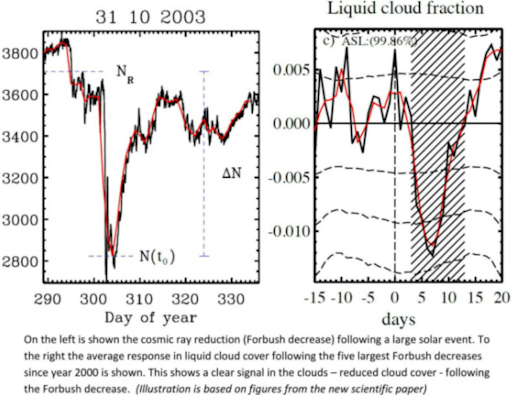
A new study just published in the Aug. 19th issue of Journal of Geophysical Research: Space Physics comes down in favor of cosmic rays. According to spaceweather.com, a team of scientists from the Technical University of Denmark (DTU) and the Hebrew University of Jerusalem has linked sudden decreases in cosmic rays to changes in Earth’s cloud cover. These rapid decreases in the observed galactic cosmic ray intensity are known as “Forbush Decreases” and tend to take place following coronal mass ejections (CMEs) in periods of high solar activity. When the sun is active (i.e., solar storms, CMEs), the magnetic field of the plasma solar wind sweeps some of the galactic cosmic rays away from Earth. In periods of low solar activity, more cosmic rays bombard the earth. The term “Forbush Decrease” was named after the American physicist Scott E. Forbush, who studied cosmic rays in the 1930s and 1940s.
The research team led by Jacob Svensmark of DTU identified the strongest 26 “Forbush Decreases” between 1987 and 2007, and looked at ground-based and satellite records of cloud cover to see what happened. In a recent press release, their conclusions were summarized as follows: “[Strong “Forbush Decreases”] cause a reduction in cloud fraction of about 2 percent corresponding to roughly a billion tonnes of liquid water disappearing from the atmosphere.”
Current cosmic ray activity
We happen to be in a weak solar cycle (24) which is actually on pace to be the weakest cycle in more than one hundred years. Therefore, it would not be surprising to have relatively high cosmic ray penetration into the Earth’s atmosphere; especially, since we are now heading towards the next solar minimum phase when solar activity is generally even quieter.
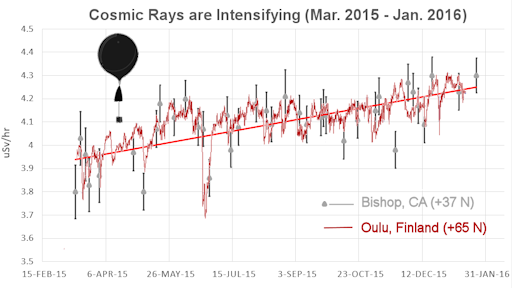
In fact, for the past year, neutron monitors around the Arctic Circle have sensed an increasing intensity of cosmic rays. Polar latitudes are a good place to make such measurements, because Earth’s magnetic field funnels and concentrates cosmic radiation there. As it turns out, Earth’s poles aren’t the only place cosmic rays are intensifying. “Spaceweather.com” has led an effort in the launching of helium balloons to the stratosphere to measure radiation, and they find the same trend increasing intensity of cosmic rays over California [For more on this study click here]:
Vencore Weather, 29 August 2016
Paul Dorian
For the past year, neutron monitors around the Arctic Circle have sensed an increasing intensity of cosmic rays.
This colorized picture of the sun is a mosaic of ultraviolet images from the orbiting TRACE satellite sensitive to light emitted by highly charged iron atoms. Growing in number, the intricate structures visible are the Sun’s hot active regions with temperatures over a million degrees Fahrenheit and their associated magnetic loops (courtesy NASA)
Overview
It has long been widely accepted that the sun is absolutely critical to all weather and climate here on Earth and yet there are still some aspects of this connection that are not too well understood and even controversial. For example, there has been the belief by many atmospheric scientists that cosmic rays which penetrate the Earth’s atmosphere from outer space can play a significant role in the formation of clouds which, in turn, has a direct impact on climate. Solar activity has a direct impact on the ability of cosmic rays to actually reach the Earth’s atmosphere. A just published study has confirmed the notion that cosmic rays can indeed be an important player in Earth’s weather and climate and the role of the sun is critical.
Cosmic rays and clouds
Cosmic rays are high-velocity particles of enormous energy that bombard the Earth from outside the solar system. The exact origin of cosmic rays has long been a mystery in the field of astronomy. Cosmic rays may produce showers of secondary particles that penetrate and impact the Earth’s atmosphere and sometimes even reach the surface. The connection between cosmic rays and clouds has been under investigation in recent years and somewhat controversial. Some researchers have held the belief that cosmic rays hitting Earth’s atmosphere create aerosols which, in turn, seed clouds and thereby help in the formation of clouds. This would make cosmic rays an important player in weather and climate. Other researchers, however, have been dubious. The skeptics have maintained that although some laboratory experiments have supported the idea that cosmic rays help to seed clouds, the effect is likely too small to substantially affect the cloudiness of our planet and have an important impact on climate.
It has long been widely accepted that the sun is absolutely critical to all weather and climate here on Earth and yet there are still some aspects of this connection that are not too well understood and even controversial. For example, there has been the belief by many atmospheric scientists that cosmic rays which penetrate the Earth’s atmosphere from outer space can play a significant role in the formation of clouds which, in turn, has a direct impact on climate. Solar activity has a direct impact on the ability of cosmic rays to actually reach the Earth’s atmosphere. A just published study has confirmed the notion that cosmic rays can indeed be an important player in Earth’s weather and climate and the role of the sun is critical.
Cosmic rays and clouds
Cosmic rays are high-velocity particles of enormous energy that bombard the Earth from outside the solar system. The exact origin of cosmic rays has long been a mystery in the field of astronomy. Cosmic rays may produce showers of secondary particles that penetrate and impact the Earth’s atmosphere and sometimes even reach the surface. The connection between cosmic rays and clouds has been under investigation in recent years and somewhat controversial. Some researchers have held the belief that cosmic rays hitting Earth’s atmosphere create aerosols which, in turn, seed clouds and thereby help in the formation of clouds. This would make cosmic rays an important player in weather and climate. Other researchers, however, have been dubious. The skeptics have maintained that although some laboratory experiments have supported the idea that cosmic rays help to seed clouds, the effect is likely too small to substantially affect the cloudiness of our planet and have an important impact on climate.
Findings from a just published study
A new study just published in the Aug. 19th issue of Journal of Geophysical Research: Space Physics comes down in favor of cosmic rays. According to spaceweather.com, a team of scientists from the Technical University of Denmark (DTU) and the Hebrew University of Jerusalem has linked sudden decreases in cosmic rays to changes in Earth’s cloud cover. These rapid decreases in the observed galactic cosmic ray intensity are known as “Forbush Decreases” and tend to take place following coronal mass ejections (CMEs) in periods of high solar activity. When the sun is active (i.e., solar storms, CMEs), the magnetic field of the plasma solar wind sweeps some of the galactic cosmic rays away from Earth. In periods of low solar activity, more cosmic rays bombard the earth. The term “Forbush Decrease” was named after the American physicist Scott E. Forbush, who studied cosmic rays in the 1930s and 1940s.
The research team led by Jacob Svensmark of DTU identified the strongest 26 “Forbush Decreases” between 1987 and 2007, and looked at ground-based and satellite records of cloud cover to see what happened. In a recent press release, their conclusions were summarized as follows: “[Strong “Forbush Decreases”] cause a reduction in cloud fraction of about 2 percent corresponding to roughly a billion tonnes of liquid water disappearing from the atmosphere.”
Current cosmic ray activity
We happen to be in a weak solar cycle (24) which is actually on pace to be the weakest cycle in more than one hundred years. Therefore, it would not be surprising to have relatively high cosmic ray penetration into the Earth’s atmosphere; especially, since we are now heading towards the next solar minimum phase when solar activity is generally even quieter.
In fact, for the past year, neutron monitors around the Arctic Circle have sensed an increasing intensity of cosmic rays. Polar latitudes are a good place to make such measurements, because Earth’s magnetic field funnels and concentrates cosmic radiation there. As it turns out, Earth’s poles aren’t the only place cosmic rays are intensifying. “Spaceweather.com” has led an effort in the launching of helium balloons to the stratosphere to measure radiation, and they find the same trend increasing intensity of cosmic rays over California [For more on this study click here]:
Wednesday, 31 August 2016
IS THE GREENHOUSE EFFECT REAL OR NOT?
On some blogs, such as Roy Spencer's there are many in-depth discussions on the validity of the Greenhouse Effect. These often only lead to greater confusion, but here is one discussion that I came across recently that seems very convincing and is put forward in a very simple way without the mathematical formulae which put off many non-scientists.
Tuesday, 30 August 2016
EARTH WARMING FOR 200 YEARS SAY EXPERTS
Here is a piece that refers to a study that concludes that the earth has been warming for around 200 years. In other words since the end of the Little Ice Age - something which most sceptics would agree with. The problem for the experts is that they have to explain how the warming was caused when CO2 emissions were practically non-existent.
Monday, 29 August 2016
SIR ANTONY JAY - BBC NEEDS TO BE CUT BACK
This piece is by the brilliant writer, Sir Antony Jay, who wrote the "yes Minister" series. Sadly he has recently died, but his wise words about cutting back the BBC still make complete sense. Unfortunately the government did not heed the advice.
Sunday, 28 August 2016
SCOTTISH OIL REVENUES COLLAPSE
This article gives the details. without the oil revenues the Scottish government would have a very weak case for an independent Scotland. The Scottish government are in a bit of a quandary as they are completely sold on the idea of not using fossil fuels, while at the same time they are heavily dependent on revenue from the same fossil fuels. Climate alarmists have such a difficult life.
Saturday, 27 August 2016
CLIMATE AFFECTED BY SOLAR ACTIVITY, CLIMATE NOT CONTROLLABLE BY MAN
This article refers to a scientific study that confirms that cloud cover is affected by solar activity. This in turn means that the climate is affected by something much more powerful and completely outside of human control. This may come as a shock to some, but in simple terms it means the climate is not controllable.
Friday, 26 August 2016
SCIENTIST'S OWN GOAL ON ICE FREE ARCTIC ICE PREDICTION
This piece explains how an alarmist prediction of an imminent ice-free arctic ocean could easily back fire if it doesn't come true. These alarmists are gamblers in order to grab a headline, but in the end they are likely to come unstuck.
Thursday, 25 August 2016
GW DAMAGE TO CORAL - IS IT 5% OR 93%?
This article refers to a new report that completely contradicts an earlier report on the extent of damage to coral reefs caused by global warming. The contrast could not be starker one report says 5% of coral was damaged and the other 93%. Which to believe?
Wednesday, 24 August 2016
GREENHOUSE GAS CONTROVERSY, PART 2 OF "EARTH - OUR HABITABLE PLANET"
Here is the link to part 2 of the series. This part includes the section on Greenhouse Gases which, though much of it is accepted, contains some material that suggests that CO2 plays a more prominent part than it does. For example half way down there is a pie chart showing the amount that the various greenhouse gases contribute to the warming effect. It claims that CO2 contributes 50%, but the table omits water vapour which is by far the most important greenhouse gas and is responsible for at least 70% (and up to 90% at times). This is a common occurrence in teaching and it seems odd that well qualified lecturers should make such an error. If water vapour had been included then CO2 contribution would go down to around 5-10%. I can only conclude that these lecturers are complicit in enhancing the part played by CO2, though why I am not sure. Maybe it's just for a quiet life!
For Part 1 of the notes here is the link.
For Part 1 of the notes here is the link.
Tuesday, 23 August 2016
EXAGGERATED CLAIMS ABOUT CORAL SENSITIVITY FOUND TO BE WRONG
Giant Coral Reef That ‘Died’ In 2003 Teeming With Life AgainThe New York Times, 15 August 2016
Karen Weintraub
In 2003, researchers declared Coral Castles dead. Then in 2015, a team of marine biologists was stunned and overjoyed to find the giant coral reef once again teeming with life.

A giant clam in the Phoenix Islands Protected Area. Credit Craig Cook/Undersea Medical
Then in 2015, a team of marine biologists was stunned and overjoyed to find Coral Castles, genus Acropora, once again teeming with life. But the rebound came with a big question: Could the enormous and presumably still fragile coral survive what would be the hottest year on record?
This month, the Massachusetts-based research team finished a new exploration of the reefs in the secluded Phoenix Islands, a tiny Pacific archipelago, and were thrilled by what they saw. When they splashed out of an inflatable dinghy to examine Coral Castles closely, they were greeted with a vista of bright greens and purples — unmistakable signs of life.
“Everything looked just magnificent,” said Jan Witting, the expedition’s chief scientist and a researcher at Sea Education Association, based in Woods Hole, Mass.

Divers from the New England Aquarium surveying reefs in the Phoenix Islands Protected Area last September. Credit Craig Cook/Undersea Medical
Global climate change is wreaking havoc on corals worldwide. Coral bleaching has caused extensive damage to regions extending from the Great Barrier Reef to the Caribbean and nearly everywhere in between.
“Threats to tropical coral reefs worldwide have escalated to a level that imperils the survival of these complex, diverse and beautiful ecosystems,” Janice M. Lough, an Australian researcher, wrote in a February opinion piece in Nature.
Coral can be severely damaged by rising water temperatures, which cause acidification, as well as by pollution and human activity like tourism, fishing and shipping – prompting some governments to restrict such activities.
If Coral Castles can continue to revive after years of apparent lifelessness, even as water temperatures rise, there might be hope for other reefs with similar damage, said another team member, Randi Rotjan, a research scientist who led and tracked the Phoenix Islands expedition from her base at the New England Aquarium in Boston.
No one actually knows what drives reef resilience or even what a coral reef looks like as it is rebounding. In remote, hard-to-get-to places, our understanding of coral is roughly akin to a doctor’s knowing only what a patient looks like in perfect health and after death, Dr. Rotjan said.
Coral Castles’s revival might be an isolated situation, a fluke in a faraway place. But Dr. Rotjan and her team are on a quest to find out why this coral and other reefs nearby came back to life.
Monday, 22 August 2016
AUSSIE TV SHOW WHERE SCIENTIST, BRIAN COX PUTS IMAGE OVER SUBSTANCE
This piece looks at a discussion programme on Australian TV where a panel of 'expert's give their answers to questions from the audience. TV scientist, Brian Cox seems unable to give a convincing answer as to the reality of global warming as he blusters with arguments from authority and dodgy graphs. See the clip for yourself at the link above
Sunday, 21 August 2016
DECLINING TRUST IN SCIENCE
This article gives the details of why scientists are trusted less, and a lot of it is to do with them straying into the area of politics, in particular the issue of so-called climate change, or global warming.
Saturday, 20 August 2016
UK's CLIMATE CHANGE POLICY CAUSES TOXIC BUSINESS ENVIRONMENT
This report gives the details of the hidden dangers of the UK's climate change policy on business, at a time when we need to give business a boost to ensure our success, post leaving the EU.
Friday, 19 August 2016
UK GOVERNMENT GROSSLY UNDERESTIMATES THE COST OF THE CLIMATE CHANGE ACT
This article lays bare the deceit perpetrated on the British people. By artificially inflating the wholesale price of electricity the cost of subsidising renewables in years to come is grossly understated. By 2030, the annual cost will be £15.6 billion, instead of the £8.0 billion claimed. Over the next fifteen years, the total cost will be £157 billion. Again, remember that this does not include the cost of providing standby capacity.
Thursday, 18 August 2016
SUPERB SET OF LECTURE NOTES
This blog has been going since 2007 and I have built up a long list of links on the right hand side which are very informative and I wonder how many readers use them? I have noticed a big increase in the number of readers in recent weeks from all over the world, including Russia and Eastern Europe as well as Asia. Welcome to everyone.
I thought it might be useful to highlight some of these links to you, so I will start with a superb set of lecture notes from the University of Indiana, Bloomington by Professor Schieber, on the topic "Earth - Our Habitable Planet". Here is a link to the first part of the series. One of the chapters has been on the links list for some years, but in such a long list it could easily get over-looked. I have re-titled it to give it a more relevant title. There is a lot of material there. It is more like a textbook and should be read in short chunks, but it is mainly easy to read, though some scientific knowledge is useful for a complete understanding.
The next set of lectures cannot be obtained from the link on the website, but I have a link from Professor Schieber and I will be looking at these in a later post, including his notes on the Greenhouse Gases, in which I fear he seems to take the alarmist line. But despite this one disappointment I still believe these are a good set of lecture notes.
I thought it might be useful to highlight some of these links to you, so I will start with a superb set of lecture notes from the University of Indiana, Bloomington by Professor Schieber, on the topic "Earth - Our Habitable Planet". Here is a link to the first part of the series. One of the chapters has been on the links list for some years, but in such a long list it could easily get over-looked. I have re-titled it to give it a more relevant title. There is a lot of material there. It is more like a textbook and should be read in short chunks, but it is mainly easy to read, though some scientific knowledge is useful for a complete understanding.
The next set of lectures cannot be obtained from the link on the website, but I have a link from Professor Schieber and I will be looking at these in a later post, including his notes on the Greenhouse Gases, in which I fear he seems to take the alarmist line. But despite this one disappointment I still believe these are a good set of lecture notes.
Wednesday, 17 August 2016
BIG CHILL: 'SUBSTANTIAL COOLING' PREDICTED WITHIN THE NEXT FEW YEARS
Here's a cheery thought for all UK readers:
Daily Star, 14 August 2016
Joshua Nevett
Climate boffins believe the UK’s topsy-turvy climate is in for a chilly twist within the next few years as three major forms of climate change trigger “substantial cooling”.

Drastic changes in ocean conditions, greenhouse gases and a weakening of the sun threaten increasingly worsening winters of blistering blizzards and severe snowstorms for years to come.
This cocktail of climate threats, paired with “hasty climate policies”, could mean “rolling blackouts” in the UK over the next few years, plunging the country into long period of darkness.
These “worse case scenario” climate threats will hit the elderly hardest, leaving “some pensioners alone in the dark” on a freezing nights resigned to a “lonely death”.
An intense La Nina weather front could wreak havoc on the UK’s climate, photo Getty
It is thought these will be brought about for the most part by a massive decrease in solar activity, meaning fewer “sunspots” and solar flares to warm up earth.
Scientists recently warned the sun’s activity is at its lowest for 100 years, meaning earth is experiencing eerily similar conditions to the period when the last mini ice age hit.
This drop in sunspot activity leads to a so-called Maunder Minimum, which is believed to be responsible for the cripplingly cold winters Europe experienced three centuries ago.
The last time Britain entered a Maunder minimum period was in the 1600s, when temperatures sunk so low, London’s river Thames froze over.
Drawing on 400 years of sunspot observations, experts believe we are heading for a similar temperature “minimum”.
However, Grahame Madge, meteorologist for the Met Office, told Daily Star Online although a “grand solar minimum” is expected, it will do little to counteract global warming caused by man-made change.
Another major factor in the predicted cool down could be the switch from an usually strong El Nino to a La Nina weather front in the pacific ocean.
Meteorologist for AccuWeather Tyler Roys told Daily Star Online La Nina could contribute to the chilly mix.
He said that the onset of La Nina – which is associated with cooler temperatures – has a much more drastic effect on weather in the British Isles and could spell a climate cool down.
He said: “Looking at the similarities of 1998 to last years El Nino event, one can assume there could be such a drop off.”
La Nina has more of an effect on the weather for the British Isles than El Nino does.
“A La Nina that is based over the eastern Pacific Ocean tends for favour a cooler and drier then normal weather pattern for much of western Europe.”
The Met Office said the onset of La Nina from 2017 is likely to “buck the trend” in terms of record breaking global temperature averages, predicting a cool down across the globe.
Daily Star, 14 August 2016
Joshua Nevett
Climate boffins believe the UK’s topsy-turvy climate is in for a chilly twist within the next few years as three major forms of climate change trigger “substantial cooling”.
Drastic changes in ocean conditions, greenhouse gases and a weakening of the sun threaten increasingly worsening winters of blistering blizzards and severe snowstorms for years to come.
This cocktail of climate threats, paired with “hasty climate policies”, could mean “rolling blackouts” in the UK over the next few years, plunging the country into long period of darkness.
These “worse case scenario” climate threats will hit the elderly hardest, leaving “some pensioners alone in the dark” on a freezing nights resigned to a “lonely death”.
An intense La Nina weather front could wreak havoc on the UK’s climate, photo Getty
It is thought these will be brought about for the most part by a massive decrease in solar activity, meaning fewer “sunspots” and solar flares to warm up earth.
Scientists recently warned the sun’s activity is at its lowest for 100 years, meaning earth is experiencing eerily similar conditions to the period when the last mini ice age hit.
This drop in sunspot activity leads to a so-called Maunder Minimum, which is believed to be responsible for the cripplingly cold winters Europe experienced three centuries ago.
The last time Britain entered a Maunder minimum period was in the 1600s, when temperatures sunk so low, London’s river Thames froze over.
Drawing on 400 years of sunspot observations, experts believe we are heading for a similar temperature “minimum”.
However, Grahame Madge, meteorologist for the Met Office, told Daily Star Online although a “grand solar minimum” is expected, it will do little to counteract global warming caused by man-made change.
Another major factor in the predicted cool down could be the switch from an usually strong El Nino to a La Nina weather front in the pacific ocean.
Meteorologist for AccuWeather Tyler Roys told Daily Star Online La Nina could contribute to the chilly mix.
He said that the onset of La Nina – which is associated with cooler temperatures – has a much more drastic effect on weather in the British Isles and could spell a climate cool down.
He said: “Looking at the similarities of 1998 to last years El Nino event, one can assume there could be such a drop off.”
La Nina has more of an effect on the weather for the British Isles than El Nino does.
“A La Nina that is based over the eastern Pacific Ocean tends for favour a cooler and drier then normal weather pattern for much of western Europe.”
The Met Office said the onset of La Nina from 2017 is likely to “buck the trend” in terms of record breaking global temperature averages, predicting a cool down across the globe.
Subscribe to:
Posts (Atom)