Saturday, 5 August 2017

USA COAL EXPORTS SOAR TO BOOST TRUMP ENERGY AGENDA


Reuters, 28 July 2017

WASHINGTON/LONDON (Reuters) – U.S. coal exports have jumped more than 60 percent this year due to soaring demand from Europe and Asia, according to a Reuters review of government data, allowing President Donald Trump’s administration to claim that efforts to revive the battered industry are working.


The increased shipments came as the European Union and other U.S. allies heaped criticism on the Trump administration for its rejection of the Paris Climate Accord, a deal agreed by nearly 200 countries to cut carbon emissions from the burning of fossil fuels like coal.

The previously unpublished figures provided to Reuters by the U.S. Energy Information Administration showed exports of the fuel from January through May totalled 36.79 million tons, up 60.3 percent from 22.94 million tons in the same period in 2016. While reflecting a bounce from 2016, the shipments remained well-below volumes recorded in equivalent periods the previous five years.

They included a surge to several European countries during the 2017 period, including a 175 percent increase in shipments to the United Kingdom, and a doubling to France – which had suffered a series of nuclear power plant outages that required it and regional neighbours to rely more heavily on coal.

“If Europe wants to lecture Trump on climate then EU member states need transition plans to phase out polluting coal,” said Laurence Watson, a data scientist working on coal at independent think tank Carbon Tracker Initiative in London.

Nicole Bockstaller, a spokeswoman at the EU Commission’s Energy and Climate Action department, said that the EU’s coal imports have generally been on a downward trend since 2006, albeit with seasonable variations like high demand during cold snaps in the winter.

Overall exports to European nations totalled 16 million tons in the first five months of this year, up from 10.5 million in the same period last year, according to the figures. Exports to Asia meanwhile, totalled 12.3 million tons, compared to 6.2 million tons in the year-earlier period.

Trump had campaigned on a promise to “cancel” the Paris deal and sweep away Obama-era environmental regulations to help coal miners, whose output last year sank to the lowest level since 1978. The industry has been battered for years by surging supplies of cheaper natural gas, brought on by better drilling technologies, and increased use of natural gas to fuel power plants.

His administration has since sought to kill scores of pending regulations he said threatened industries like coal mining, and reversed a ban on new coal leasing on federal lands.

Taking Credit

Both the coal industry and the Trump administration said the rising exports of both steam coal, used to generate electricity, and metallurgical coal, used in heavy industry, were evidence that Trump’s agenda was having a positive impact.

“Simply to know that coal no longer has to fight the government – that has to have some effect on investment decisions and in the outlook by companies, producers and utilities that use coal,” said Luke Popovich, a spokesman for the National Mining Association.

Shaylyn Hynes, a spokeswoman at the U.S. Energy Department, said: “These numbers clearly show that the Trump Administration’s policies are helping to revive an industry that was the target of costly and job killing overregulation from Washington for far too long.”

Friday, 4 August 2017

UK'S FIRST COMMERCIAL SHALE WELL TO BE DRILLED


Financial Times, 27 July 2017

The first commercial fracking well in the UK is set to be drilled within weeks in spite of strong opposition from protesters at the site near Blackpool.

Image result for frack on gwpf

Lorries brought a drilling rig to the Lancashire site of shale gas explorer Cuadrilla during the early hours of Thursday under police escort, before anti-fracking activists could block the company’s main gate.

But in an indication of how protesters are determined to try to disrupt Cuadrilla’s operations, later in the day four activists from environmental group Reclaim the Power locked themselves inside cars at the site entrance and placed their arms in concrete so they could not be moved without being injured.

Cuadrilla has had to wait six years to frack again after causing a minor earthquake near Blackpool during a test in 2011.

After securing planning permission from the government last year to frack at a different site in Lancashire, Cuadrilla now hopes to start a long-awaited shale gas revolution in the UK similar to that witnessed in the US.

Britain has an estimated 1,300tn cubic feet of shale gas reserves, mainly in the north of England and the Midlands, according to the British Geological Survey. If 10 per cent could be extracted, it could satisfy the UK’s total gas needs for 50 years, based on current consumption levels, the government has calculated.

Thursday, 3 August 2017

DOES THE PAST MASSIVE SUPPORT FOR EUGENICS HAVE A LESSON FOR TODAY'S GW ALARMISM?

Imagine that there is a new scientific theory that warns of an impending crisis, and points to a way out.
This theory quickly draws support from leading scientists, politicians and celebrities around the world. Research is funded by distinguished philanthropies, and carried out at prestigious universities. The crisis is reported frequently in the media. The science is taught in college and high school classrooms.
I don’t mean global warming. I’m talking about another theory, which rose to prominence a century ago.
Its supporters included Theodore Roosevelt, Woodrow Wilson, and Winston Churchill. It was approved by Supreme Court justices Oliver Wendell Holmes and Louis Brandeis, who ruled in its favour. The famous names who supported it included Alexander Graham Bell, inventor of the telephone; activist Margaret Sanger; botanist Luther Burbank; Leland Stanford, founder of Stanford University; the novelist H. G. Wells; the playwright George Bernard Shaw; and hundreds of others. Nobel Prize winners gave support. Research was backed by the Carnegie and Rockefeller Foundations. The Cold Springs Harbour Institute was built to carry out this research, but important work was also done at Harvard, Yale, Princeton, Stanford and Johns Hopkins. Legislation to address the crisis was passed in states from New York to California.
These efforts had the support of the National Academy of Sciences, the American Medical Association, and the National Research Council. It was said that if Jesus were alive, he would have supported this effort.
All in all, the research, legislation and moulding of public opinion surrounding the theory went on for almost half a century. Those who opposed the theory were shouted down and called reactionary, blind to reality, or just plain ignorant. But in hindsight, what is surprising is that so few people objected. Today, we know that this famous theory that gained so much support was actually pseudoscience. The crisis it claimed was non existent. And the actions taken in the name of theory were morally and criminally wrong. Ultimately, they led to the deaths of millions of people. [...]
I am not arguing that global warming is the same as eugenics. But the similarities are not superficial. And I do claim that open and frank discussion of the data, and of the issues, is being suppressed. Leading scientific journals have taken strong editorial positions of the side of global warming, which, I argue, they have no business doing. Under the circumstances, any scientist who has doubts understands clearly that they will be wise to mute their expression.
One proof of this suppression is the fact that so many of the outspoken critics of global warming are retired professors. These individuals are not longer seeking grants, and no longer have to face colleagues whose grant applications and career advancement may be jeopardized by their criticisms.
In science, the old men are usually wrong. But in politics, the old men are wise, counsel caution, and in the end are often right.
The past history of human belief is a cautionary tale. We have killed thousands of our fellow human beings because we believed they had signed a contract with the devil, and had become witches. We still kill more than a thousand people each year for witchcraft. In my view, there is only one hope for humankind to emerge from what Carl Sagan called “the demon-haunted world” of our past. That hope is science.
But as Alston Chase put it, “when the search for truth is confused with political advocacy, the pursuit of knowledge is reduced to the quest for power.”
That is the danger we now face. And this is why the intermixing of science and politics is a bad combination, with a bad history. We must remember the history, and be certain that what we present to the world as knowledge is disinterested and honest.

Full essay

Wednesday, 2 August 2017

CAN THERE BE A COMPROMISE ON CLIMATE POLICY?

Have you viewed the recent talk given to the GWPF by Roger Pielke Jr? You can access it here. It is quite a lengthy video including about an hour of questions. I found it irrelevant as it was about reaching a "consensus" on how to deal with climate policy, and so Pielke presumed that it was necessary to deal with a problem, whereas I do not accept that there is a problem. Yes I accept that CO2 may cause slight warming as its concentration in the atmosphere doubles from 0.03% to 0.06%, but as that is predicted to be around 1 degree C, and that other factors may even reduce that or even eliminate it, there is no reason for a policy at this time.

I found it hard to hear the questions from the audience as they were not given a microphone and many of them did not seem to have good diction. From the answers given I do not think any of them put forward my point above, which I found a little surprising as I would have thought that among climate sceptics a lot would share my view. No one also suggested that the political "solutions" put forward, such as the Paris accord, were not fair and neither did they work in terms of preventing future increase in CO2 world-wide.

In fact the world's governments can never reach a total agreement on any issue, which is bad news if it were imperative that they did in order to save us from any real threat. Mr Pielke tries to be reasonable by wanting to reach a consensus, but it is no surprise to me that he is disliked by the main protagonists from both sides. He reminds me of the UK prime minister who tried to reach agreement with Hitler just before the start of the second world war, Neville Chamberlain. He was a decent man who wanted to avoid war, but it could not be avoided.   

Tuesday, 1 August 2017

ROADS POLLUTION HEALTH ISSUE IS JUST A COVER FOR THE CO2 REDUCTION NONSENSE

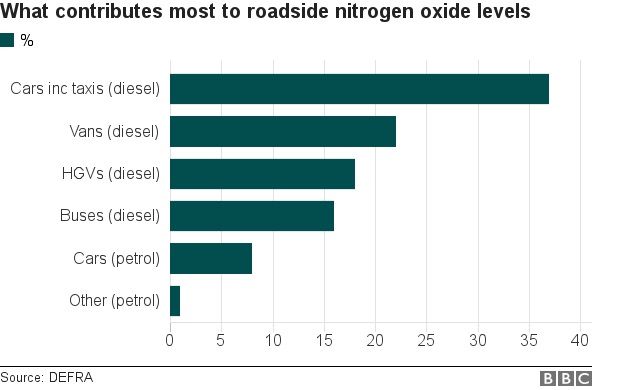
Look at this chart showing which vehicles produce the most nitrogen oxides and you can see clearly that petrol vehicles (8%) produce far less than diesels (37%), and yet the government want to phase out both at the same time. They know the public are much more concerned by possible health issues and so they hope they will think that petrol and diesel are both equally bad.

Air pollution
The announcement to ban the sale of new petrol and diesel engine cars in 2040 is going to hang over future governments with increasing fear as the date draws nearer. What if electric car sales fail to take off, what next? Will they increases tax on petrol and diesel to give people a nudge? And what if there is an early big uptake of electric vehicles? Then we will find the electricity grid under increasing strain as more and more home charging goes on. We might well find the lights start going out and power cuts become the norm. Then we may find that our batteries are not charged for work - in fact they may even remove charge from them to "balance out" the grid. Motorists will not be very happy, to put it mildly. But this government need not worry. They will be long gone before all this could happen. 

Monday, 31 July 2017

GERMAN STATES PUT JOBS BEFORE CLIMATE TARGET


Breaking News, 18 July 2017

Germany is at risk of tacitly joining Donald Trump in turning its back on the Paris climate change deal. Two of the country’s regional governments have decided to put preserving jobs in coal mines and power plants ahead of cutting carbon emissions.

If Europe’s largest economy misses its targets, Chancellor Angela Merkel’s environmental credentials – and the global accord itself – would suffer a big setback.

Officially, Germany is fully committed to the Paris accord. At the G20 summit in Hamburg earlier this month, Merkel said she “deplored” Trump’s decision to withdraw the United States from the treaty. She led an alliance of world leaders who unsuccessfully tried to persuade the U.S. President to reconsider.

Yet two important German states are undermining Merkel’s position. North Rhine-Westphalia (NRW) and Brandenburg are home to many mines which extract brown coal and power plants that burn the carbon-intensive fuel. Their governments have vowed to protect an industry that provides more than 70,000 jobs, many of them in economically deprived regions in the country’s east.

That’s bad news for Germany’s promise to reduce overall emissions by at least 55 percent, relative to 1990, by 2030. Per unit of electricity generated, brown coal produces twice as much carbon as gas-fired power plants. In 2016, the fuel accounted for 23 percent of Germany’s electricity but emitted 50 percent of the sector’s carbon dioxide. Brown coal reserves are expected to last for several decades, and utilities even have permission to open several new mines.

NRW’s new government, which is led by Merkel’s conservative Christian Democratic Union, in late June decided to stick to the current mining plans in the region. In mid-June, Brandenburg’s government said it wanted to soften its 2030 reduction targets. A study commissioned by the World Wildlife Fund environmental group shows that NRW’s plans alone would bust Germany’s Paris targets.

Unless Merkel can rein in the brown coal enthusiasts at home, she risks sending a devastating message to the world. If a country as rich and ecologically conscious as Germany prioritises coal mining jobs over the fight against global warming, others will also find it easier to turn their back on the treaty.


Sunday, 30 July 2017

UK GOVERNMENT ELECTRIC CAR POLICY STARTS TO UNRAVEL


The Daily Telegraph, 26 July 2017

Plans to ban the sale of new diesel and petrol cars by 2040 in a bid to encourage people to buy electric vehicles are a “tall order” and will place unprecedented strain on the National Grid, motoring experts have warned.

Michael Gove, the Environment Secretary, has warned that Britain “can’t carry on” with petrol and diesel cars because of the damage that they are doing to people’s health and the planet. “There is no alternative to embracing new technology,” he said.

However the AA warned that the National Grid would be under pressure to “cope with a mass switch-on after the evening rush hour”, while Which? Car magazine warned that electric cars are currently more expensive and less practical.

According to a National Grid report, peak demand for electricity will add around 30 gigawatts to the current peak of 61GW – an increase of 50 per cent.

The extra electricity needed will be the equivalent of almost 10 times the total power output of the new Hinckley Point C nuclear power station being built in Somerset.

National Grid predicts Britain will become increasingly reliant on imported electricity, which will rise from around 10 per cent of total electricity to around one third, raising questions about energy security.

Just 4 per cent of new car sales are for electric vehicles, and concerns have also been raised about whether Britain will have enough charging points for the new generation of cars.

Saturday, 29 July 2017

HOW WILL THE GOVERNMENT SOLVE THE PROBLEM OF GAS HEATING?

Another excellent piece by Paul Homewood examines a gaping hole in the government's pointless effort to decarbonise the UK. The only alternatives they have to gas are either electric heating or convert methane to hydrogen. Both are much more expensive than our current use of gas and in the case of electricity, likely to be much less reliable, that is if the huge increase in electricity required can be delivered at all. We are living in a mad era. All self-inflicted and utterly pointless. I would love to know what future historians will make of it all.

Friday, 28 July 2017

PARIS AGREEMENT IS JUST HOT AIR AND HYPOCRITICAL NONSENSE

Read this and you will understand what I mean. While the leading nations of the world go to these lavish conferences and solemnly pledge to do all they can to "fight climate change", the moment it is over they quietly carry on just as before. I am sure that they don't actually believe a word of all this guff about "saving the planet". They give lip-service to it so as to appear like good boys, and  hope to get any handouts from the slush funds if they get the chance. Surely the people can see through the pretence by now, or are some blind?

Thursday, 27 July 2017

HALF HOUR ELECTRICITY BILLING TO COME IN 2019 - BIG BROTHER IS COMING!

This news item may not get wide coverage but it is an indication that there is a lot going on that will eventually catch up with us when it has already been decided.

This article shows us how it is being presented. A lot of people will see it as Big Brother watching us closely and turning our appliances on and off when it suits them. Those with Smart Meters will be rewarded and the rest will be punished with higher bills. Resistance is useless - you will obey!

Wednesday, 26 July 2017

NEW DIESEL AND PETROL VEHICLES TO BE BANNED IN UK FROM 2040

This report says so. Of course 2040 is still a long way off and they still have the problem of the millions of cars that will already be on the road at that time. It is still an intriguing prospect and I would love to see if it actually happens, or will it be rescinded by some future government nearer the time. Or will some new technology make electric cars redundant? It is just too far into the future to speculate - but that is what the government seems to be doing.

Tuesday, 25 July 2017

HYPOCRISY AND THE LEADING GLOBAL WARMING PROPAGANDA MERCHANTS

Global warming propaganda merchants and hypocrisy go hand in hand.
  • Hillary Clinton promised to buy carbon offsets to atone for her private jets, but never bothered;
  • Al Gore thinks cashing in on climate and Lincoln freeing the slaves are the same thing; and
  • Bill Nye (the politicized science guy) wants those of us who correct the record on climate dead.
Could they be any more selfish, self-aggrandizing and false?

Bill Nye can't wait for greying Americans to shuffle off.  Think he's eager to go himself?

CFACT's Marc Morano explained on Fox that Nye is "confident he can convert the young people to climate action but he is having trouble with anyone his age and older because frankly they’re wiser and they have experienced a lot, so they are less susceptible to his propaganda.”

Monday, 24 July 2017

RECENTLY PUBLISHED LETTER ON CLIMATE CHANGE

The following letter was published in the Southern Daily Echo on 20 July 2017:

This letter was written in response to a reader (Jock Macdonald) who quoted Professor Stephen Hawking who claimed the Earth would end up like Venus with runaway warming and surface temperatures in hundreds of degrees C.

Professor Got It Wrong

I see that Jock Macdonald quoted professor Hawking as though the words of a renowned professor must be true.

As far as I am aware professor Hawing has never studied climate science and his words should be given as much scrutiny as anyone else's

I found it extraordinary that he should make such alarming pronouncements about the Earth becoming like Venus, without being asked to provide a shred of evidence. No credible climate scientist has ever made such a claim to  my knowledge.

The Venusian atmosphere has 96% CO2 whereas Earth has 0.04%.

If Jock Macdonald did a little more research he would find that far from disappearing, Arctic ice has halted its decline over the last few years. In fact none of the so-called tipping points ever seem to happen.

A few years ago we were told that global warming would lead to long hot summers. When this failed to happen we were told that it's the climate which would suddenly become unstable.

The fact is that heatwaves, floods and hurricanes are now happening at about the same rate as they always have. Don't take my word for it, check out the facts with the Intergovernmental Panel on Climate Change.  

Sunday, 23 July 2017

HINKLEY POINT NUCLEAR POWER PLANT - A LOUSY DEAL FOR THE UK

This article looks at the figures and finds that they are awful for the UK and yet the government is now in so deep that they cannot get out without massive damage to their credibility and reputation. Of course this whole deal would be completely unnecessary if it were not for the fact that the government is determined to cut CO2 emissions in a vain and pointless attempt to save the planet while all around them the rest of the world are carrying on regardless. Future generations will look back on this in the same way as we view the Southsea Bubble.

Saturday, 22 July 2017

50 SOLAR PV COMPANIES GO BUST IN JAPAN IN 2017

This article explains the reason, which is simply that they could not compete without subsidies. With all the talk about theses renewables being able to compete and even being cheaper than fossil fuels, this gives a definitive answer to those who doubted it was true.

Friday, 21 July 2017

WHY RENEWABLE ENERGY IS A DEAD END

Here is a very good article to explain why renewable energy will not power the future. Just read it to see how our government has been fooled into spending billions of pounds just to make a very expensive gesture to appease the green fanatics. It's time the public were told the truth so they can talk to the politicians, but the TV companies would never broadcast this truth. They would rather continue the deception and feel good about themselves.

Thursday, 20 July 2017

ANOTHER ALARMIST CLIMATE SCIENTIST THREATENS TO SUE THOSE WHO DISAGREE WITH HIM

This piece explains how Mark Jacobson, the Stanford engineering professor who became the darling of the green Left by repeatedly claiming the U.S. economy can run solely on renewable energy, has threatened to take legal action against the authors of an article that demolished his claims last month in the Proceedings of the National Academy of Sciences.


Wednesday, 19 July 2017

CAN WE DO WITHOUT FOSSIL FUELS? HERE'S WHY NOT

Here's a thought-provoking piece from the Scientific Alliance on the question of what happens when we try to do away with fossil fuels. The article has a lot of interesting statistics to show that we currently do not have a good enough strategy and unless we go for nuclear energy we are basically stuffed.  There is simply no point in doing away with the internal combustion engine or gas central heating if the electricity that is used to replace it has to be generated by using fossil fuels as we would actually end up using more of them than we do at present. Wind and solar will never be available on a big enough scale ( or at the required reliability). We must either wait for totally new technology or go for nuclear at increased cost.

Tuesday, 18 July 2017

SURFACE TEMPERATURE CHANGES MIGHT BE SIMPLY DUE TO CHANGES IN CLOUD COVER

Here is a good article that discusses this idea. I am sure there are other factors involved, but it is obvious to anyone who has been outside on a warm sunny day that as soon as clouds block off the sun for a few minutes this has a great effect on the temperature. Even though all recorded temperatures are taken in shade I believe that clouds will have an overall effect, not just on the temperature in direct sunlight. One other consideration is that increased cloud cover at night will raise the temperature by reflecting some of the outgoing long wave infra red radiation back down to earth, thus slowing the cooling. On balance I am not sure of the total effect, but it must be considered.

Monday, 17 July 2017

SURVEY ON PUBLIC KNOWLEDGE AND ATTITUDE TO CLIMATE CHANGE AND THE SEA

This large survey looks at how the public perceives the effect of man's behaviour on the sea. Having read it I believe it goes beyond "climate change", as it lumps together pollution (such as effluent etc.) along with CO2. I am not convinced that surveys like this are very accurate, but they are still interesting in a general way. Worth reading in full if you have the time.

It throws up some positives such as "54% of European citizens believe that humans play only a partial role or no role in climate change."

Many who thought that they were well informed on the impacts of climate change on the ocean believe scenarios that may happen by 2100 if we do not reduce greenhouse gas emissions have already occurred e.g. loss of Arctic sea-ice in the summer (26% of respondents) and sea temperature increases of more than 2°C (30% of respondents). I am not surprised given the media coverage.

Sunday, 16 July 2017

TURKEY DECIDES NOT TO SAVE THE PLANET - AS USA CASH NO LONGER AVAILABLE

This article explains the situation. So much for a "planetary emergency". This confirms what we always knew - that this is all about the money.

Saturday, 15 July 2017

THE PERILS OF GROUPTHINK - AS PRACTICED BY THE BANK OF ENGLAND

Here is a very thoughtful piece from James Delingpole.  He is a very good writer and makes an excellent case for the requirement of balance in official reports by institutions like the Bank of England. This is nothing new, of course. It is simply one more example where only one side of the argument is considered, ie that fossil fuels are bad and will be phased out soon. It is both a lazy and foolish conclusion and one that is unlikely to be fulfilled (certainly not in the developing world). 

Friday, 14 July 2017

BATTLE OF THE SATELLITE DATA SETS - RSS v UAH

This piece summarises what is happening. As a simple introduction, there are two different data sets of the temperature of the troposphere. One is produced by Remote Sensing Systems (RSS), and the other is produced by the University of Alabama Huntsville (UAH). Both data sets have been updated at various times to improve their results. The linked article is by Jo Nova and it shows why UAH seems to be the most reliable of the two. 

Thursday, 13 July 2017

THE GRENFELL DISASTER CAUSED BY INFERIOR EU REGULATIONS PUTTING CLIMATE CHANGE ABOVE SAFETY

This piece from Christopher Booker exposes the whole shambles in a clear concise manner. When will our political masters learn to stop compromising and do the right thing?

Wednesday, 12 July 2017

ARE TINY PARTICLES IN OUR AIR A DANGER TO US?

This is a very important question as the quest to make our air ever cleaner gets ever harder and more expensive - very expensive indeed. We are constantly bombarded with very scary stories about this, and quite rightly we are very concerned. Of course by far the biggest polluter of our lungs is smoking and most of us now believe that this is a very harmful activity, and yet around 20% of us still light up. Compared with smoking, the amount of small particles we breathe in our city air here in the West is much lower and yet we are being warned that "there is no safe level" of these particles. As the fear of climate change is declining it is becoming very important to the alarmists that the public believe that removing these particles is essential at any cost. So here is an interesting article on this subject.

Tuesday, 11 July 2017

EXPOSED - A LACK OF INTEGRITY IN SCIENTIFIC RESEARCH INTO NEONICS

This article is mainly about the recent trials into the possible damage to bee colonies from exposure to neonicotenoids (neonics) used to treat seeds and prevent pests from attacking crops. It is, of course very relevant to the climate change hypothesis, as the first part of the article alludes to some studies into the effects of fine particulates and claims the effects have been exaggerated.  

Monday, 10 July 2017

RAMPANT ALARMISM BEING TAUGHT IN USA SCHOOLS

This is the finding of one investigative journalist. The problem is that there is such a low understanding of this subject among teachers that it is all too easy for misinformation to be taught to unsuspecting students whose parents may also be uninformed. Fortunately many students are resistant to accepting the establishment position and are only too keen to argue over any controversial subject.

Sunday, 9 July 2017

AUSSIE ELECTRIC PRICES GO THROUGH THE ROOF

This piece explains. Here in the UK we seem to be heading in the same direction and one would hope that our politicians would sit up and take notice, but sadly there is no evidence of this happening. Theresa May, when asked about climate change at the G-20 summit, mouthed some platitudes about wanting the USA to get back into the Paris Accord. Jeremy Corbyn (Labour leader) is of the same opinion, even though his brother Piers is a confirmed sceptic.

Saturday, 8 July 2017

TRUMP ADMINISTRATION PLANS TO CHALLENGE CLIMATE SCIENCE IN SERIES OF DEBATES

Here is an article that explains the situation. I think this will be a revelation to the public and could well spell the end for this massive scare story. I wonder if the climate alarmists will actually put someone forward to represent them.

Friday, 7 July 2017

BREAKING NEWS - MANN REFUSES TO GIVE HIS DATA TO COURT AND FACES RUIN

This article gives the details of the latest twist in the long-running libel case involving scientists Dr Tim Ball and Dr Michael Mann (who was responsible for the infamous hockey stick graph of world temperatures. 

Thursday, 6 July 2017

ALL THE DOOM LADEN PREDICTIONS OVER THE PAST 45 YEARS HAVE FAILED

This piece looks at the predictions of doom made over the past 45 years. Noto one of them actually came true, you will not be surprised to learn.

Wednesday, 5 July 2017

PROF. HAWKING GETS OUT OF HIS DEPTH ON CLIMATE CHANGE

Professor Stephen Hawking is probably the most famous living scientist, so when he speaks, his words are given a much greater significance than those of less well known scientists. He may be an expert on black holes and cosmic radiation, but how much has he studied climate? Here is his latest pronouncement on the subject of climate change:

His main concern during his latest interview was the future of our species. A particular worry was President Trump's decision to withdraw from the Paris climate agreement to reduce CO2 levels.

"We are close to the tipping point where global warming becomes irreversible. Trump's action could push the Earth over the brink, to become like Venus, with a temperature of two hundred and fifty degrees, and raining sulphuric acid," he told BBC News.
"Climate change is one of the great dangers we face, and it's one we can prevent if we act now. By denying the evidence for climate change, and pulling out of the Paris Climate Agreement, Donald Trump will cause avoidable environmental damage to our beautiful planet, endangering the natural world, for us and our children."

For such an intelligent man I am surprised that he has so readily bought in to the alarmist meme. As with many such articles it leaves me wishing I could ask him to really justify his pronouncements. How does he know "we are close to a tipping point"? He is allowed to make the claim without any challenge. His other claims are equally bizarre. He gets away with parroting the alarmist lines without any justification. As for Earth becoming like Venus, that is an extraordinary claim that even pro-alarmist climate scientists have not made. He gives not one shred of evidence for it and nor was it challenged. Propaganda, pure and simple. I would really like to see him rebut something like this article, for example. But this he would never do.

I wonder if he has given much serious study of the science. He is just a well known person, like Prince Charles and the Pope who has a following among the public and as many of the public know nothing of the science either they will be likely to take notice of someone that they believe will know more than they do.

Tuesday, 4 July 2017

THE BLEAK FUTURE FOR UK MOTORISTS

Is this the future for motorists in the UK? Regular readers of this blog will know that the UK government are trying to drive people off the roads in a number of ways if they are using fossil-fuelled cars. The linked article refers to a new report by NICE, a worthy organisation, but who seem to be getting rather OTT in protecting us from even the smallest risk. 

Monday, 3 July 2017

IS OUR AIR WORSE THAN IN THE 1950'S?

Daily Telegraph 17/04/17

Michael Fitzpatrick GP

As somebody who groped his way to school through winter smogs in
Sheffield in the Fifties and Sixties, I have always been sceptical
about the claims of environmental campaigners that air pollution in
British cities is now reaching critical levels of toxicity. I recall
playing football on pitches where neither goal was visible from the
halfway line. No doubt any therapeutic benefits were outweighed by the
damage to our youthful lungs.

Yet recent headlines proclaim that our children are being exposed to
illegal levels of toxic air, and London mayor Sadiq Khan has declared
a public health emergency. He quotes epidemiological studies claiming
9,000 Londoners are dying prematurely each year due to poor air
quality. Estimates of national fatalities have increased from 40,000
to 60,000 per year.

It is worth recalling that the Great Smog of December 1952, widely
regarded as an environmental catastrophe, killed only 4,000 people in
London. Can it really be true that air pollution is now killing more
than twice that number every year in the capital, and 10 to 15 times
as many nationwide?

Well, no. On closer inspection, it turns out that these are not actual
deaths, but estimates, produced by mathematical modelling, of the
number of premature deaths that can be attributed to air pollution.
The figures are derived from calculations of the "years of life" lost
across the whole population resulting from the increased risks
associated with particular pollutants. According to Cambridge risk
statistician Prof David Spiegelhalter, another way of presenting the
same data would be to state that the average loss of life expectancy
over the whole adult population is... three days.

It is true that the character of air pollution has changed. Whereas we
inhaled soot and sulphur oxides as the by-products of burning coal,
our children are now inhaling particulates and nitrogen oxides, partly
because of the last Labour government's "green" incentives to persuade
us all to switch to diesel-fuelled cars.

However, levels of particulates and nitrogen oxides have been falling
steadily for decades - they are now about a quarter of what they were
in 1970. It is also worth noting that air pollution in London is about
one eighth of that in Delhi, a quarter of that in Beijing, and lower
than that in Paris.

In the words of Brighton respiratory physician Prof Anthony Frew, who
served on the original Royal College of Physicians' working party on
air pollution, the claim of 9,000 deaths in London is a "zombie
statistic - however much you try to kill it, it comes back and it's
simply not true".

Further reference H/T Paul Withrington.

http://www.transport-watch.co.uk/topic-34-great-dirty-diesel-scare-0

Sunday, 2 July 2017

TRUMP TO UNLEASH THE VAST ENERGY WEALTH OF THE USA


Bloomberg, 29 June 2017

Jennifer A Dlouhy

  • President reorients energy policy away from climate change
  • Trump Says U.S. Is on the Cusp of an 'Energy Revolution'


President Donald Trump said he is lifting an Obama-era policy that curtailed the financing of coal-fired power plants overseas, as he seeks to reorient the U.S. government away from fighting climate change and toward American "energy dominance."

"We are now on the cusp of a true energy revolution," Trump told a crowd of executives, lobbyists and laborers at the Energy Department on Thursday. "We are a top producer of petroleum and the No. 1 producer of natural gas. We have so much more than we ever thought possible. We are really in the driver’s seat."

Trump is celebrating growing U.S. energy exports he says are leading to "millions and millions of jobs" and acting as a force for peace around the world. After decades of dependence on foreign oil, the U.S. is on the verge of becoming a net exporter of energy resources.

"The United States’ big competitive advantage today is low energy prices," White House economic adviser Gary Cohn said in a discussion with other Trump administration officials before the president’s address. "We are no longer a victim of having to import our hydrocarbons; having to import our oil."

As part of the White House “Energy Week,” Trump highlighted growing U.S. energy production and reversals of environmental regulations issued under former President Barack Obama’s tenure. In place of major policy announcements Thursday, Trump emphasized how cutting regulation and encouraging domestic fossil fuel producers will help the American economy and benefit American foreign policy.

Trump detailed the previous steps he has taken to lift regulations curbing domestic energy production, including moving to rescind rules throttling greenhouse gas emissions from power plants. He also is pulling the U.S. out of the landmark Paris climate accord, in which nearly 200 countries pledged to slash carbon dioxide emissions.

The biggest change he revealed is a reversal on restrictions by the World Bank and other multilateral development banks for financing coal plants in developing nations. The policy was implemented under President Barack Obama. Supporters of the restrictions say they helped combat climate change, while critics say they thwarted the development of advanced coal plants that produce fewer emissions.

Trump also announced a comprehensive review of U.S. nuclear power policy, which could lead to an interagency assessment of how to solve some of the industry’s biggest challenges, including storing spent radioactive waste and competing against low-cost natural gas and wind power.

And Trump described new deals aimed at sending U.S. liquefied natural gas to customers in Asia. For instance, Energy Transfer Partners and Royal Dutch Shell Plc on Wednesday signed a memorandum of understanding to evaluate collaborating on a liquefied natural gas export project in Louisiana. Trump also touted Sempra Energy’s decision to sign an agreement to begin negotiations over selling more liquefied natural gas to South Korea.

He also described U.S. exports of coal to Ukraine, where power plants are built to handle anthracite mined in areas fraught with conflict. Coal exports to Ukraine "will have more to do with keeping our allies free and building their confidence in us than anything I’ve seen," said Energy Secretary Rick Perry.

Saturday, 1 July 2017

WILL UK TAKE UP ELECTRIC VEHICLES? - IF SO, THE GOVERNMENT WILL LOSE TAX REVENUE

It appears that the Treasury is banking on increasing revenues from road users, whereas the Climate Change department expect us to take up electric vehicles in large numbers. This article explains this odd conundrum. Who is going to be right? I tend to agree with Paul Homewood who favours the Treasury, but time will tell.

Friday, 30 June 2017

SOLAR MINIMUM IS COMING

This short film clip from NASA gives a very informative look at what is happening. As the sun changes it allows more comic rays to penetrate the Earth's atmosphere, which some scientists believe will lead to greater cloud cover and a slight cooling of the Earth.

Thursday, 29 June 2017

LINK BETWEEN CO2 RISE AND SURFACE TEMPERATURE GETTING WEAKER AS PAUSE CONTINUES

New paper shows that the pause in global temperature rise is real and continues while CO2 continues to rise.  All climate models project that temperatures should not be levelling off, but should be increasing (despite interannual variability).

Wednesday, 28 June 2017

GLOBAL WARMING ALARM PREDICTIONS FAIL TO MATERIALISE

This article Looks at some of the scary predictions made by climate alarmists. Here is a flavour of the article:

"It's summer 2017 and the Arctic was supposed to be ice-free, hurricanes were going to be more frequent and more deadly, and sea levels should be rising alarmingly. Al Gore swore in his 2006 science fiction movie, "An Inconvenient Truth," that within a decade there would be a "true planetary emergency."

Each failed prediction weakens the case for alarmist climate change, but there is still a long way to go before the issue goes away.

Tuesday, 27 June 2017

RESEARCH ANALYSIS PROVES THAT CO2 DOES NOT CONTROL THE CLIMATE

This article explains how thorough research failed to find that the steadily rising atmospheric CO2 concentrations have had a statistically significant impact on any of the 14 temperature data sets that were analysed. The tropospheric and surface temperature data measurements that were analysed were taken by many different entities using balloons, satellites, buoys and various land based techniques. Needless to say, if regardless of data source, the analysis results are the same, the analysis findings should be considered highly credible.

These research results clearly demonstrate that once the solar, volcanic and oceanic activity, that is natural factor impacts on temperature data are accounted for, there is no “record setting” warming to be concerned about. In fact, there is no Natural Factor Adjusted Warming at all.

"THE BATTLE AGAINST CLIMATE CHANGE IS LIKE THE FIGHT AGAINST SLAVERY", SAYS AL

The Goracle speaks truth unto humanity in his crusade against the evil CO2 emitters. This has all the hallmarks of a religion, where everything has to be taken on trust with no questioning of core beliefs. I think the slaves themselves would want to tell Mr Gore of a few differences. For a start slavery could be seen happening and there was no doubt that people were being oppressed.  Global warming is so small and benign that no one has seen it and no one is being oppressed. Perhaps someone should tell him. 

Monday, 26 June 2017

IS IT POSSIBLE TO POWER THE USA GRID WITH 100% RENEWABLES?

Here's a great look at what's going on in the energy world . I found this website to be most informative. The piece about whether the USA electricity grid could go over to 100% renewables by 2050 is particularly fascinating. One professor says "yes", while another group says "no". What do you think?

Sunday, 25 June 2017

HOW ICE DATA PROVES CO2 DOES NOT CONTROL THE CLIMATE

This article shows that CO2 follows temperature with highly variable time lags depending upon whether the climate is warming or cooling. At the onset of the last glaciation the time lag was 8,000 years and the world was cast into the depths of an ice age with CO2 variance evidently contributing little to the large fall in temperature.

Saturday, 24 June 2017

WHY SHOULD WE TRUST THE GOVERNMENT?

One of the pillars of the current climate change phenomenon is the government, complete with the opposition and even the third and fourth parties in parliament. All these politicians, with the exception of a very small number of honourable dissenters, are constantly telling us that "the science is settled", we face an emergency (or crisis) due to emissions of CO2. And yet time and time again these same politicians are found wanting. They were sure it was a good idea to invade Afghanistan, Iraq, Libya, even Syria, though in the latter case there was sufficient dissent to stop them. We were told to buy diesel cars. We also trusted that they could protect us from fires with ever stricter fire regulations.  Now we know better.

But have we learnt anything from their mistakes? I think those of us who have lived through all the mistakes have, but young voters who have not lived through probably have not.  Hence the large number of young voters who voted for extreme socialist policies at our recent election.

Once the public have seen the political class to be deeply flawed they may become even more cynical about their extreme adherence to what look like very dubious and extremely costly climate change policies.

Friday, 23 June 2017

BANK OF ENGLAND BIASED RESPONSE TO CLIMATE CHANGE POLICIES

This article explains that by focusing only on risks to carbon intensive assets, whilst ignoring the possibility that current climate policies may be causing poor investment opportunities in renewable energy technologies, the Bank of England is failing in its statutory duty to identify and address risks to the resilience of the UK financial system.  Nowhere in the Bank's document looking at risks tot the UK economy is there any evidence that they recognises that the very large investments in renewables, the Bank itself mentions “tens of trillions of dollars”, are themselves risky. Like the rest of the debate on climate change there can be no room for doubt.

The Bank of England writes that: "The allocation of capital and labour to projects not aligned with climate policies and technological changes could be a drag on productivity and economic growth. Conversely, allocating capital and labour to green technologies can be growth-enhancing".

Then again it might, and not at all improbably, be quite the other way around. Failing to allocate resources to projects not aligned with climate policies may destroy wealth, and directing them instead to green technologies could well reduce productivity and suppress growth. There is, no doubt, a real possibility that the policy driven commitment of capital resources to renewable energy generation is malinvestment that will have to be written off within a decade or two. This especially true if new technology emerges such as nuclear fusion, or other yet unknown methods of energy production.

Much will depend on what the rest of the world does (not what it says it will do).  

Thursday, 22 June 2017

EARTH'S SURFACE TEMPERATURE - A LOOK AT THE HISTORICAL CONTEXT

This piece puts the present climate debate into its long term context. This is essential for all of us if we are to learn the full picture of where we are. It is what is missing from all the alarmist headlines that we read about in the news and the pronouncements of the "true believers" in Greenpeace or the Friends of the Earth etc.

Wednesday, 21 June 2017

THE TWO SIDES OF THE CLIMATE DEBATE SIDE BY SIDE

This piece shows how a very plausible article written by a climate scientist can be debunked easily by someone with a good understanding of the facts - something very few members of the public have. It is very instructive to read the linked piece right through to see how the facts can be misrepresented.

Tuesday, 20 June 2017

RECENT UK FLOODING NOT UNPRECEDENTED SAYS NEW STUDY

This report puts the recent spate of floods in the UK into context over a much longer period. That is the only way to assess weather or climate.  The study proves that though the past decade was wetter than many recent decades it was no wetter than many other periods going further back. The trouble is that we humans have relatively short lives and even shorter memories. The only reliable thing is data.

Monday, 19 June 2017

WHAT THE PARIS ACCORD WOULD REALLY MEAN (AND COST!)

This data-packed essay looks at the full implications of the Paris climate accord. When you read it you can see the logic behind President Trump's decision to pull the USA out. Princeton physicist Will Happer wrote of this essay, "Most of your essays are very good, but this one is especially so.  Many thanks for all you are doing for our country." I agree.

Sunday, 18 June 2017

NO LINK BETWEEN AIR QUALITY AND ACUTE DEATHS, SAYS STUDY

This paper explains that the association between air quality and acute deaths is not causally related, contrary to the popular belief that is constantly being put out by mainstream media. Of course the public are far more concerned about the affects of air quality on health than they are on some vague assertion that emissions of CO2 will in some way affect the climate at an unspecified time in the distant future. This paper should give some reassurance on the health issues related to air quality.

Saturday, 17 June 2017

UK GOVERNMENT U-TURNS ON DIESEL CARS, BUT WHY DID THEY GET IT WRONG?

The UK government had been encouraging us to drive diesel vehicles since the early 2000's. The reason was to reduce our emissions of CO2, as they claim this will improve the climate, or prevent it deteriorating at some point in the future. Now they have been told by the EU that our vehicles are emitting too much nitrogen oxides (NOx) and to reduce this they are now trying to reduce the number of diesel vehicles. However they already knew that diesels produced more NOx gases (which are bad for those with lung problems like asthma). They claim they were duped by the car manufacturers who claimed that these emissions were being controlled. That is a poor excuse, as surely they ought to have tested these vehicles independently? What this shows is how easily the government can be fooled by accepting the word of others and go on to put in place very costly policies which they then discover are completely wrong.

In order to comply with their own Climate Change Act, the government would like to get us all to drive electric vehicles, or at least hybrid electric/petrol. They cannot do this straight away, as it would cause massive opposition from the public and massive costs to the government, so they are starting to "nudge" us in this direction by mandating councils to set up Clean Air Zones. They do not say what these zones will require, but it seems obvious that they will ban diesels - but will they go much further than that and only allow electric/hybrids? If so then they are going beyond what is necessary to make the air clean enough to be safe. They would be effectively banning diesel and petrol engines from our town centres in order to comply with their so-called climate change commitments.

Regular readers may have noticed that I have recently put the cost of the UK Climate Change Act on the top right of the blog. It is an eye-watering figure of £300 to 400 billion up to 2050. It is rarely stated publically but should be shown as often as possible. The benefits to the public of this massive spend I have said are NONE.

Friday, 16 June 2017

ELECTRIC CAR BATTERIES RELEASE AS MUCH CO2 AS DRIVING A PETROL CAR FOR 8 YEARS, SAYS NEW STUDY

New Study: Large CO2 Emissions From Batteries Of Electric Cars
New Technology, 29 May 2017

Johan Kristensson
 
Enormous hope rests on electric cars as the solution by the motor industry to climate change. However the batteries of electric cars are not environmentally friendly when manufactured. Several tonnes of carbon dioxide are being released, even before electric batteries leave the factory.


IVL, the Swedish Environment Institute has, on behalf of the Swedish Transport Administration and the Swedish Energy Agency, investigated the climate impact of lithium-ion batteries from a life-cycle perspective. Batteries for electric cars were included in the study. Lisbeth Dahllöf and Mia Romare have produced a meta-analysis, that is, a review and compilation of existing studies.
 
The report shows that battery manufacturing leads to high CO2 emissions. For each kilowatt-hour storage capacity in the battery, emissions of 150 to 200 kilograms of carbon dioxide equivalent are generated, already in the factory.

The researchers have not studied individual car brand’s batteries, just how they were produced or what electrical mix they used. But to understand the importance of battery size here’s one example: Two standard electric cars on the market, Nissan Leaf and Tesla Model S, have batteries of approximately 30 kWh and 100 kWh respectively.

As soon as you buy the car, CO2 emissions of approximately 5.3 tonnes and 17.5 tonnes, respectively, have been released for batteries of these sizes. The numbers may be difficult to relate to. By way of comparison, a trip for a person returning from Stockholm to New York by air causes emissions of more than 600 kilograms of carbon dioxide, according to the UN organization ICAO’s calculation model.

Another conclusion of the study is that about half of the emissions occur during the production of raw materials and half during the production of the battery in the factory. The mining itself accounts for only a small part of between 10-20 percent.
The calculation is based on the assumption that the electricity mix used by the battery plant is based on more than half the power  being generated by fossil fuels. In Sweden, power generation predominantly consists of zero-carbon nuclear and hydropower, as a result of which lower emissions can be achieved.

The study also reveals that CO2 emissions rise almost linearly with battery size, even though data is scarcer in this area. This means that a Tesla-size battery contributes more than three times as much CO2 as Nissan Leaf’s battery. It is a result that surprised Mia Romare.

“It should have been less linear because the electronics used do not increase to the same extent. But the battery cells themselves are as influential as the production looks today, she says.

“One conclusion is that you should not drive unnecessarily cars with large batteries,” says Mia Romare.

The authors emphasise that a large part of their study was about finding out what data was available and finding out what information they hold. In many cases they found that it was difficult to compare existing studies with each other.

“We have been frustrated, but it is also part of the result,” says Lisbeth Dahllöf.
Mats-Ola Larsson, their colleague at IVL, has calculated how long you need to drive a petrol or diesel car before it has released as much carbon dioxide as an electric car battery. The result was 2.7 years for a battery of the same size as Nissan Leaf and 8.2 years for a battery of Tesla size, based on a series of assumptions.

“It’s great for companies and government to embark on ambitious environmental policies and to buy climate-smart cars. But these results show that one should not think of choosing an electric car with a larger battery than necessary, he says, and points out that politicians should also address this in the design of instruments.

An obvious part to look at in life cycle analyses is recovery. The authors of the report note that what characterises batteries is the lack of the same as there is no financial incentive to send the batteries for recycling and that the volumes are still small.

Cobalt, nickel and copper are recycled, but not the energy required to make the electrodes, says Mia Romare, pointing out that recycling points are resource conservation rather than carbon dioxide emissions.

Peter Kasche from the Energy Agency, the publishers of the report, stresses the importance of the close relationship between the size of the electric battery and CO2 emissions.

One really needs to make sure to optimise electric batteries. One should not drive around with a lot of kilowatt hours unnecessarily. In some cases, a plug in-hybrid may be the optimum, in other cases a clean battery device.

Thursday, 15 June 2017

ANOTHER CLIMATE PREDICTION GOES BELLY UP

In this article we see how a short term trend can be easily used to make quite wrong predictions for the longer term. This kind of thing is all too prevalent in the eagerness of climate alarmists to make out their case. But when the trend ends or changes they are left with egg on their faces.


Not long ago California was in drought.
Senator Barbara Boxer famously told us, “In California, we can just look out the window to see climate change’s impacts.”
Sorry, Senator, science doesn’t work that way.
Since then, of course, El Niño / La Niña current and weather patterns kept right on naturally doing their thing and California and the West experienced tremendous precipitation and replenished reservoirs from deep snow melt.
Our weather, extreme or otherwise, remains well within the range of historic norms.
According to a NASA study released Monday, climate computer models have been predicting a drier Earth than real-world observations show.
details at CFACT.org:
“NASA and four universities compared climate data from 1995 to 2005 to 23 climate model simulations for the same period. More than 70 percent of the climate models underestimated the amount of rain compared to real world observations.”
Although far from perfect, computer simulations can be very valuable for short-term meteorology, including such important applications as forecasting hurricane tracks.
The climate, however, is incredibly chaotic and complex.
Long-term climate simulations have never come close to being accurate.
Global warming politics makes them worse.
Computer simulations are currently not sufficiently reliable to be the main determinant of energy, economic or climate policy.
They may never be.

Wednesday, 14 June 2017

MILLIONS OF POOR PEOPLE GO WITHOUT ELECTRICITY TO "SAVE THE PLANET"

 As Donald Trump pulls out of the Paris deal on climate change, questions are being asked about aid money to build solar plants in countries that export the electricity


At the end of May, Zimbabwe’s state monopoly, ZESA, reached a last-minute deal to continue importing electricity.
ZESA owed $43m to South Africa and Mozambique and, with part-payment and terms agreed for clearing the debt, neither country turned off the flow.
South Africa is a continental giant, but one might ask why Mozambique is selling to anyone, given 80 per cent of her own people are not connected to the grid and, even in Maputo or Beira, supply is so unreliable that homes and shops have their own generators.

But Mozambique ranks among the world's 20 largest exporters of electricity, chiefly from Cabora Basa dam on the Zambesi River, a short way from Kariba. And here's the irony. Not far east of Cabora


But Uganda is the biggest external supplier of power to Kenya, East Africa’s largest economy, while at home only one-in-five Ugandans have the lights on.
Even the Democratic Republic of Congo, one of the world’s poorest countries, exports electricity to Zambia and South Africa while local supply languishes around 15 per cent. Kinshasa receives billions in aid from the US, Britain and Europe, much of it for “green” projects.

“A matter of shame”
When it comes to numbers, India has more people than all of Africa, squashed into about 10 per cent of the space. And, here, electricity is political.
In Delhi, the minister for power, Piyush Goyal says it’s “a matter of shame”, that after nearly seven decades of independence from Britain, “we have not been able to provide a basic amenity like electricity.”
In truth, they’ve done better than many former colonies, but out of 1.2 billion Indians, an estimated 300 million (more than the SADC countries combined) are yet to be connected.
At the 2014 election, prime minister Narendra Modi promised to end this within his term, and with the next vote less than two years away, he’s been racing to make it happen.
The government has also rolled out a record number of solar plants with a pledge that, by 2022, three per cent of power will come from renewables. Last year the World Bank assigned more than $600m to the plan.
But connecting just a million homes needs an estimated 10 000 acres of solar panels and, in a country where land is scarce, this has become an issue.
Former Irish president Mary Robinson who served as UN high commissioner for human rights and now heads a foundation on climate issues, sounded a caution after a rise in complaints by indigenous groups.
“Recent experience shows that renewable energy installations can result in human rights being undermined if local communities are not consulted,” she said.
India only signed the Paris Accord, “contingent on receiving billions and billions and billions of dollars in foreign aid”. This was Donald Trump in full throttle recently as he withdrew America from the Paris deal on climate change.
True, Delhi does receive vast amounts of aid, and solar farms and wind turbines have become the new chic for donors and NGOs.
But with no sun at night, and the monsoon season when it rains for weeks, solar will provide less than one per cent of the country’s needs over the next five years. Instead, like South Africa and Zimbabwe, most of the power comes from coal.
And, like Mozambique, in spite of a shortfall, India sells electricity to neighbouring states, including Bangladesh.
In London, Dr Benny Peiser, director of the Global Warming Policy Foundation, a non-partisan think-tank on energy and climate, said it was, “hard to imagine a case for any kind of aid where the receiving government is exporting power while their own people go without.”
But he said “prioritising green energy schemes” was also a problem.
“Donors and NGOs may feel good installing millions of solar panels across Asia and Africa, but they ignore the fact that renewable energy is unable to provide much needed electricity when the sun isn’t shining.”
“Cheap and reliable power”
Kenya, Tanzania and Botswana are building new coal-fired power stations, Zimbabwe, Nigeria, Ghana and India are upping their use, South Africa relies on it for 93% of Eskom’s output, but if a single mine is reopened in Wyoming the green lobby treats it like an act of war.
This upsets Donald Trump who rode to office on a promise of jobs, including along the coal belt that runs through the centre and east of America.
His bombast and choice of words, attacks on other countries and endless tweets — often contradicting his own policy — have made him a target for comedians.
But it’s hard to counter his claim that, under the Paris Accord, countries like USA are expected to cut emissions now, while Africa, Asia and Latin America can go on polluting until 2030, then trim their footprint.
The president’s ire was not so much for the main agreement, but a $100bn “Green Climate Fund” that’s part of the deal. The plan is for wealthy countries to finance projects in the developing world, especially solar and wind power.
But the fact that many poor countries are exporting power while capacity remains short at home has been seized on by lobbyists in Washington.
Mr Trump’s defenders say he has not walked away from Paris, merely asked for a better treaty.
And they point to his speech: “We will start to negotiate, and we will see if we can make a deal that’s fair,” he said.
In or out of a global pact, Washington looks unlikely to pay for new generating plants that don’t maximize output and serve local communities.
Dr Peiser said it was important to remember that aid “comes from taxpayers’ money donated principally from the US, Britain and the rest of Europe.”
It could not be used, he said, “to generate costly and unreliable electricity in countries where hundreds of millions need the exact opposite: cheap and reliable power”
This, he said, had to include the latest gas and clean-coal technology.
Dr Peiser called on the US administration to review all aid linked to energy.
“That way, the most cost-effective projects can be selected to achieve their objective of helping poor nations to power their people and economies.”

Tuesday, 13 June 2017

ELECTRIC VEHICLES CAN'T COMPETE IN DENMARK WITHOUT SUBSIDY

Here is the proof that electric vehicles are not attractive to buyers without the big subsidies provided by government.  As soon as the subsidies were withdrawn the sales plummeted. The government then decided to extend the subsides to 2020. Will they ever be able to compete in a free market?  

Monday, 12 June 2017

IS THE USA GOING TO REALLY TEST THE GLOBAL WARMING THEORY?

This report explains that the new EPA chief, Scott Pruitt is considering setting up an adversarial system with "teams" of experts on both sides of the debate grilling one another publicly. Apparently those who in favour of the theory are strongly against such a move. I wonder why - are they afraid that their hypothesis will be undermined by such a process? I say bring it on!

Sunday, 11 June 2017

Saturday, 10 June 2017

WHAT DID THE PARTIES SAY ON ENERGY POLICY IN THE UK ELECTION?

This post reminds us of the policies of the UK political parties put before the people on Thursday. Of course these will have had little direct impact on the result, but it gives an idea of where the main parties stand. Unfortunately only UKIP has a really sound policy and they have no influence at all, however the Conservatives are at least better than Labour and in reality they are not really in favour of the awful Climate Change Act and many members of it would repeal it tomorrow if it were politically possible, but they fear the so-called consensus.

Friday, 9 June 2017

THE REAL COST OF OUR LOW-CARBON OBSESSION

NIGEL LAWSON  Daily Tel. 3rd June 2017

Our low-carbon obsession is costing us dear

The next government must prioritise energy that is cheap and reliable
if it is to mend public trust

Donald Trump‘s decision to withdraw the United States from the Paris
Agreement has dealt a hammer blow to an elite consensus which has
built up around the issue of climate change. That consensus has placed
cutting carbon dioxide emissions above people‘s jobs and protecting
the environment. With US industry already enjoying a substantial
competitive advantage over European firms, this decision will make
European climate policies all the more unsustainable. If Britain is to
keep up with the rest of the world, it is essential that the next
government rethinks energy policy to prioritise competitiveness and
affordability.

The 2017 Conservative manifesto has promised to do just that, and sets
a target for Britain to have the lowest energy prices in Europe. This
is a striking change of tone compared with previous manifestos, but
this objective will only be achieved through extensive reforms to
existing policies, alongside the political will to fight powerful
vested interests.

The next government will first need to acknowledge what has gone
wrong. Britain‘s obsession with unilateral decarbonisation has taken
precedence over relieving fuel poverty and keeping prices competitive.
It is inconceivable how political parties can reconcile being on the
side of working people while at the same time driving up their cost of
living. The Climate Change Act is set to cost the UK economy
approximately £320 billion by 2030 - equivalent to funding the NHS in
England for three years.

Existing energy policies that claim to be ”environmental• are nothing
of the sort. Bjorn Lomborg, the head of the Copenhagen Consensus
Centre, has estimated that even if every nation meets its pledges
under the Paris climate change agreement, the total reduction in the
planet‘s temperature will only be 0.17C by 2100. With America‘s exit,
even this paltry figure may not be achieved.

By contrast, the bad environmental consequences of energy policies
have been tangible and significant. Commitments to bioenergy are
damaging biodiversity and have distorted international food markets.
The rare earth metals used in wind turbines come from poorly regulated
mines in China which leak toxic and radioactive waste into nearby
lakes on an industrial scale, perfectly illustrating the vacuity of
the ”out of sight, out of mind• attitude of virtue-signalling ”clean•
energy advocates.

But the harmful consequences of low-carbon policies are harder to
ignore when they are right on your doorstep, or even inside your home.
Britain‘s air pollution crisis is the result of misguided low-carbon
policies that incentivised diesel cars. People have died because
politicians couldn‘t resist the desire to ”save the planet•. Recent
research also suggests that biomass power stations may not have lower
CO2 emissions than coal and gas. What will it take for politicians to
question the wisdom of spending hundreds of billions on failing
policies instead of putting the needs of ordinary families first?

Flexibility will be crucial to a more competitive approach. The
current programme of five-yearly decarbonisation targets guarantees
prohibitive costs for consumers today, and prevents the UK from taking
full advantage of the falling costs of various technologies. Renewable
energy lobbyists often claim that costs have come down to competitive
levels; this should be put to the test by the removal of subsidies
after 2020.

The manifesto also described ”the discovery and extraction of shale
gas in the US• as ”a revolution•. As a result, US manufacturers have
done even better and investors are flocking back to North America;
perhaps $160 billion has been earmarked for petrochemical plants alone
since 2012. Proposals to change the planning law for shale
applications could not come soon enough.

Energy policy in recent years has been marked out by an unhealthy
relationship between government and lobbyists from large renewable
energy firms. After leaving office, former energy secretary Ed Davey
walked into three advisory roles with firms with links to renewable
energy companies: unmistakable evidence of a ”revolving door• between
big business and government, even if no rules were broken. The power
of lobbying interests can be seen clearly in the fiasco surrounding
the Swansea Bay tidal lagoon. This project, promoted by another former
energy minister, is expected to be formally rubber-stamped by
government in the next few weeks despite being a completely uneconomic
technology. If expensive projects like this continue to get the green
light, the full benefits of the shale gas revolution are unlikely to
be realised. Stronger safeguards against corporate lobbying will lead
to better value for the taxpayer and a more competitive energy sector.

Britain‘s decision to leave the EU has illustrated a deep disconnect
between the political elite and many people in the rest of the country
who feel ignored and left behind. By leaving the Paris Agreement,
Trump has delivered on his pledge to the left-behind in America. We
too must now look beyond a narrow obsession with renewables to a
fairer alternative that prioritises cheap and reliable energy. This
will help mend broken public trust, boost the economy and put Britain
on a secure footing as we look outward to trade with the rest of the
world.

Thursday, 8 June 2017

IT ALL COMES DOWN TO THE COST OF ENERGY

John Constable: Energy Cost Is Why We Disagree About Climate PolicyGWPF Energy, 4 June 2017

Dr John Constable: GWPF Energy Editor

By withdrawing the United States from the Paris Agreement President Trump has put the burden of proof on those private investors and nation states that believe renewable energy is economically beneficial. Far from being a disaster, this is a step towards a reasonable and spontaneously attractive climate change policy.

Like many of those vilified for their views on the subject of climate change, President Trump is more of an energy policy sceptic than an anti-rational “denier” of atmospheric science. He senses, and with good reason, that the aggregate of energy policies proposed to mitigate climate change brings with it the threat of major wealth destruction and a reversal of several centuries of exponential increases in human well-being.

Mr Trump sees this from his own national perspective, believing, again with good reason, that the policies are extremely and comparatively disadvantageous to the United States. However, this narrow view is a subset of and entirely compatible with the broader conclusion that renewable energy policies will be damaging to human prospects at the global level, however much they may favour certain countries in the short term.

Those who disagree with him are, for the most part, either explicitly or implicitly affirming the contrary proposition, namely that the renewable energy transition envisioned is already economic and will bring enhanced global prosperity.

That is the black and white of the matter; you either think that the low carbon energy policies make sense, or you don’t, and it is this root level division that provides the most profound explanation of why we disagree to any extent about climate change. If there were no differences of opinion about energy, there would be hardly any disagreement about climate change policy.

Furthermore, this account not only explains the fact of the quarrel, but also the haut en bas and moralising tone of Mr Trump’s critics. If you believe that economic, low-emitting renewable energy is already available, then it will also seem to you that only ill-will and stupidity prevents its adoption, and thus that President Trump’s decision to withdraw from the Paris Agreement is ignorant at best and probably malign.

But his views are neither of these things. The reasoning is certainly elliptical, and the manner is brusque, to say the least, but in the last analysis he simply has a different view about the economic consequences of renewable energy, views that are in fact widely held amongst both specialists and the general public.

The case for renewables is not proven, and in spite of a rolling barrage of positive PR round the industry there are still very good grounds for reserving judgment. Even if the claimed equipment cost reductions are real, and this is extremely dubious in the case of wind power, the economic lifetimes remain deeply uncertain, and the electricity system integration costs for uncontrollable generators are without doubt extremely high. Upbeat babble about electricity storage, smart metering and ingenious demand management cannot conceal the fact that these “solutions” all tend towards increasing the capitalization of the electricity sector, thus greatly reducing its productivity, a clear recipe for higher consumer costs and for deeply unpleasant macroeconomic impacts.

As with many problems in technology and commerce, a resolution to this matter cannot be delivered politically or administratively. It is, to use Easterly’s convenient phrase, not a matter of administrative deployment, but a research question, the answer to which can only be discovered by free experiment and the taking of risks. Indeed, the President’s de facto rejection of state support for alternative energy actually brings this discovery closer.

A number of US corporates and other interests are now declaring that they will continue to invest in low carbon technologies in spite of the President’s decision to withdraw from the Paris Agreement. Fine. Let them do so. If the enthusiasts are right, then renewable technologies will sweep the board through fundamental and real advantage, bringing general benefit. If they are wrong, the lesson will be learned painfully and in full public view but with limited malinvestment.

So in pursuit of truth, let us remove all the deep market coercions that are currently feeding the suspicions of President Trump, amongst others. Delete the portfolio standards, abolish the tax credits and income support subsidies, and make the ‘alternative’ technologies pay their costs on the system and earn their their place in the wholesale markets through normal competition. And by all means do the same for equivalent subsidies to fossil fuels, though green campaigners will be disappointed to find that these are not nearly as common as they think.

Many “Parisians” are now consoling themselves with the thought that a Trump presidency cannot last more than eight years at the most. That is an evasion. The reality to which Mr Trump has given voice is enduring. It can be temporarily suppressed, but it will not go away. The disagreement about energy is not trivial. Cheap energy is the cause of prosperity. Climate policies grounded in anything other than cheap energy will not be sustainable.

Wednesday, 7 June 2017

BJORN LOMBORG BACKS TRUMP'S DECISION ON LEAVING PARIS ACCORD

This article confirms that Bjorn Lomborg, the self-styled Skeptical Environmentalist, believes that it is foolhardy and foolish for world leaders to stay fixated on Paris – not only will it likely falter, but it will be hugely costly and do almost nothing to fix climate change.

Here is a good piece on Lomborg's calculations (peer-reviewed) on the actual effectiveness of the Paris accord on limiting future temperature rises.

Tuesday, 6 June 2017

PARIS CLIMATE ACCORD LAID BARE BY TRUMP DECISION

This piece looks at this week's article by Christopher Booker in the Sunday Telegraph in which he expresses the view that President Trump's speech on withdrawal of the USA from the Paris agreement shows it to be a meaningless fraud. This is the dirty secret at the heart of the Paris accord. 

Monday, 5 June 2017

PUTIN JOKES ABOUT USA LEAVING THE PARIS ACCORD

This piece records some light-hearted banter by the Russian president. It doesn't appear that Putin takes the global warming meme all that seriously, just like most of the public.

Sunday, 4 June 2017

INVESTORS GIVE TRUMP THE THUMBS UP

This post looks at the behaviour of investors to the announcement by Donald Trump to take the USA out of the Paris climate accord. It seems clear that the investors think it will be good for business, despite all the negative responses of other political leaders. Interesting!

Saturday, 3 June 2017

COMMON SENSE ON CLIMATE ON THE TODAY PROGRAMME FROM ROGER HELMER

UKIP energy spokesman, Roger Helmer gave a short radio interview on his views of the USA pulling out of the Paris Accord. It was encouraging to hear such sensible views being aired. Listen here.